Free VPNs for Warzone: Safe Picks or Risky Traps?
Warzone has changed. Skill-based matchmaking keeps tightening, casual lobbies feel rare, and every session turns into a tournament. That pressure pushes players to search for shortcuts. One of the most searched solutions today is free VPNs for Warzone.
Another factor adds fuel to the problem. Internet providers throttle traffic during peak hours, especially gaming packets. Latency spikes appear out of nowhere. Gunfights feel delayed. Killcams look suspicious.
Cost also matters. New players and casual gamers hesitate before paying monthly for a VPN for Warzone without knowing if it will help. Free VPNs promise lower ping, easier lobbies, and instant fixes. Reality tells a different story.
Understanding that gap between promise and performance is the key to avoiding wasted time, unstable connections, or account risks.
2. What Warzone Actually Needs From a VPN
Warzone does not reward raw download speed. It rewards consistency.
A functional VPN for Call of Duty must deliver:
- Low latency, not high bandwidth
- Stable routing to nearby matchmaking nodes
- Console-friendly NAT compatibility
- Predictable IP behavior that does not trigger automated flags
Server distance matters more than server count. The Best Warzone Server Locations are usually the closest regional data centers, not exotic regions. Routing traffic across continents kills responsiveness.
Console players face additional challenges. The Best Console VPN must support OpenVPN or WireGuard-level tunneling, not browser-based proxies. Without proper tunneling protocols, packet loss becomes unavoidable.
3. How Free VPNs Work Behind the Scenes
Free VPNs operate on volume, not performance.
Most rely on multi-tenant infrastructure where thousands of users share a handful of IP addresses. Those IPs rotate slowly and attract abuse reports fast.
Other technical realities include:
- Severe bandwidth caps masked as fair usage
- Traffic prioritization that places gaming packets last
- Extensive logging to monetize user behavior
Gaming traffic is expensive. Real-time UDP packets consume infrastructure without offering ad revenue. As a result, Warzone traffic drops to the bottom of the priority list.
Encryption quality also suffers. Many free providers downgrade cipher strength, avoiding modern AES-256 encryption. That decision weakens best encryption for VPN security and exposes metadata.
4. Can Free VPNs Really Get Easier Warzone Lobbies?
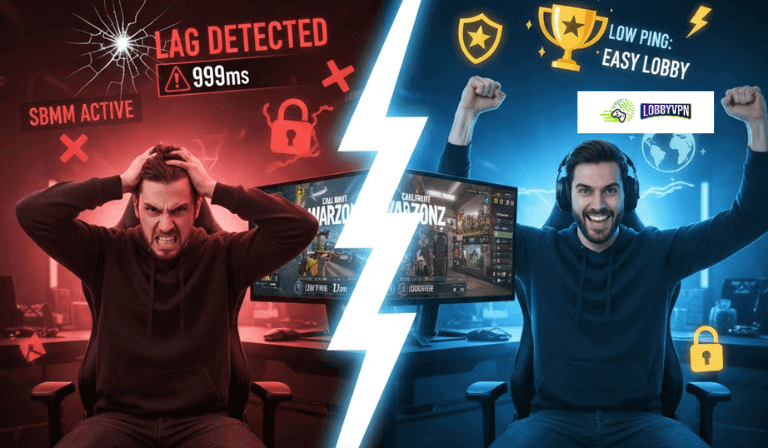
SBMM evaluates more than location. It analyzes performance history, connection stability, and IP behavior.
Free VPN IPs are heavily reused. Matchmaking systems detect those patterns quickly. Overloaded IPs often land in higher-risk pools, not easier ones.
Some players report short-term success. That usually happens when:
- A fresh IP is briefly assigned
- The VPN routes traffic through a lightly loaded region
- Session duration stays short
Results disappear fast. IP reputation degrades within days. Lobby difficulty normalizes or worsens.
That inconsistency explains why free VPNs for Warzone feel unpredictable at best and frustrating at worst.
5. Latency, Lag, and Packet Loss: The Real Cost
Latency kills gunfights. Packet loss ruins movement.
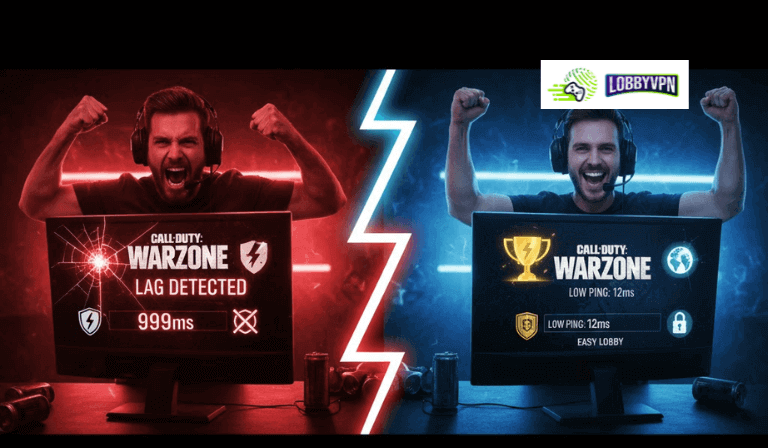
Free VPN congestion increases ping because servers lack capacity buffers. When traffic spikes, packets queue or drop. That leads to jitter during close-range fights.
Console players notice this immediately. PS5 and Xbox rely on consistent UDP flows. Free VPN routing breaks that flow.
Common symptoms include:
- Delayed hit registration
- Rubber-banding during slides
- Random disconnects mid-match
Many users attempt DNS tweaks instead. Best DNS servers for gaming can help with lookup speed, but they do not fix routing congestion. DNS vs VPN confusion causes misplaced expectations.
6. Security and Account Safety Risks
Security risks rarely get discussed in gaming forums. They should.
Free VPN IPs carry poor reputations. Cheaters, bots, and scrapers abuse them constantly. Automated systems associate those IP ranges with risk.
Consequences include:
- Shadow matchmaking
- Increased manual reviews
- Temporary account restrictions
DNS hijacking also appears frequently. Some free VPNs inject unsafe resolvers. That exposes users to malicious redirects.
Public Wi-Fi multiplies the danger. Without encrypted DNS traffic, ISPs and hotspots see every lookup. Using Google DNS for PS5 improves resolution speed but does not encrypt traffic by default.
7. Popular Free VPNs for Warzone: Honest Breakdown
Most free VPNs advertise the same benefits.
They promise unlimited speed, global servers, and gaming optimization. Reality includes:
- Limited server access
- Artificial speed caps
- No console-level support
None are engineered for FPS gaming. Transparent providers admit that openly. Marketing-heavy providers hide it behind buzzwords.
No free service currently offers stable tunneling, clean IP pools, and consistent latency suitable for competitive Warzone play.
8. When a Free VPN Might Make Sense
Free VPNs are not useless. They are just misused.
Valid scenarios include:
- Testing regional routing behavior
- Comparing nearby server latency
- Short-term troubleshooting
Avoid ranked modes. Avoid long sessions. Avoid repeated logins from rotating IPs.
Treat free VPNs as diagnostic tools, not performance solutions.
9. Free VPNs vs Low-Cost Gaming VPNs
Price differences are smaller than players assume.
Low-cost gaming VPNs invest in:
- Dedicated routing paths
- Clean IP pools
- Consistent encryption standards
SBMM behavior stabilizes. Ping remains predictable. Account risk drops significantly.
Providers building white label VPN for business platforms understand this architecture deeply. That same backend discipline benefits gaming-focused services.
10. What to Look for Instead of “Free”
Smart alternatives exist.
Prioritize services offering:
- Trial periods or money-back guarantees
- Dedicated gaming servers near your region
- Manual region selection with ping metrics
- Strong DNS handling with encrypted DNS traffic
A proper VPN for Warzone integrates DNS protection, tunneling efficiency, and IP hygiene.
11. Common Mistakes Warzone Players Make With Free VPNs
Many issues stem from configuration errors.
Avoid these mistakes:
- Connecting to distant regions
- Using browser VPNs on consoles
- Ignoring MTU and DNS settings
- Overusing VPNs during ranked play
Players asking How to Fix Lag in Call of Duty often overlook routing basics.
12. Final Verdict: Are Free VPNs for Warzone Worth It?
Free VPNs for Warzone rarely deliver what players expect. Casual testing is acceptable. Competitive play suffers. Account safety declines. Performance remains unstable.
Players serious about consistency should skip free tools and choose controlled alternatives with clear infrastructure ownership.
The right VPN does not promise miracles. It delivers predictable routing, strong encryption, and stable sessions. That difference decides whether a match feels fair or frustrating.
Choosing wisely protects both performance and progress.