
Have you ever dropped a 30-kill game one match, then suddenly found yourself struggling to break even the next?
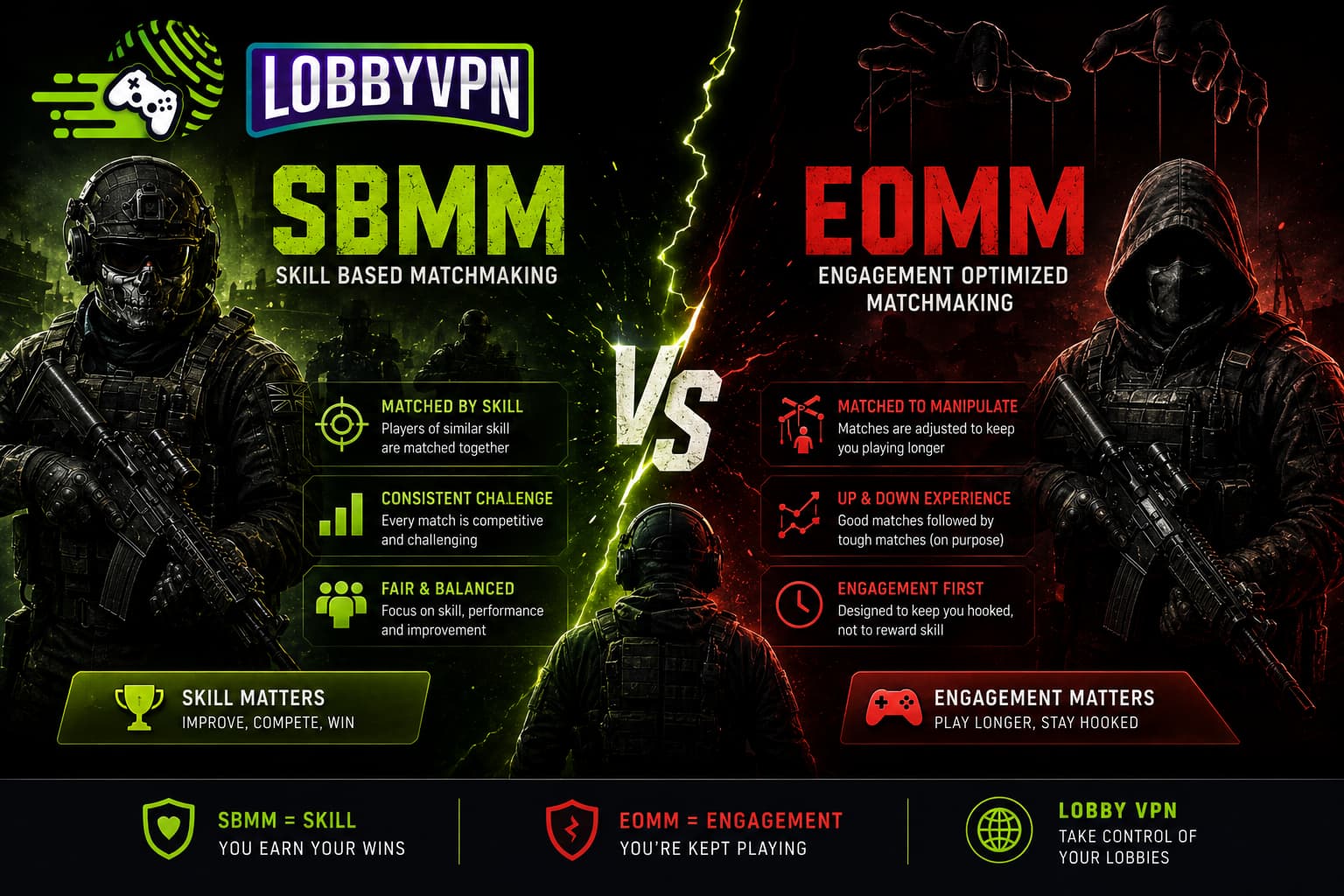
Perhaps you’ve wondered why your lobbies feel impossibly difficult after a winning streak, or why that first game of the day always seems easier than the rest. Welcome to the hidden world of SBMM vs EOMM—the two competing philosophies that secretly shape every Call of Duty match you play.
At Lobby VPN, we’ve spent years analyzing multiplayer matchmaking systems across competitive gaming titles. Moreover, we’ve heard thousands of players describe the same frustrating patterns: unpredictable lobby difficulty, mysterious skill rating fluctuations, and that nagging suspicion that something more than pure skill determines who you face. Consequently, we decided to pull back the curtain on how Activision, Infinity Ward, Treyarch, and Raven Software actually build your multiplayer lobbies.
This comprehensive guide explains SBMM vs EOMM in plain English. Furthermore, we’ll explore the groundbreaking research from Electronic Arts that introduced Engagement Optimized Matchmaking to the world. In addition, we’ll examine Activision’s controversial 2015 patent for microtransaction-driven matchmaking. By the end, you’ll understand exactly how Call of Duty determines player skill, why your lobbies feel harder some days than others, and what you can actually do about it.
What Is Skill-Based Matchmaking (SBMM)?
Skill-Based Matchmaking (SBMM) represents the traditional approach to competitive matchmaking. Essentially, this system analyzes your player performance metrics—kill/death ratio, win rate, score per minute, and other player performance metrics—then assigns you a hidden skill rating. Subsequently, the matchmaking algorithm pairs you with players who possess similar ratings.

How SBMM Works in Practice
The SBMM system operates through several core components:
Table
| Component | Function | Example |
|---|---|---|
| Skill Rating (MMR/SR) | Numerical representation of player ability | ELO, TrueSkill, or proprietary systems |
| Matchmaking Pools | Groupings of players within similar skill brackets | Bronze, Silver, Gold tiers (hidden) |
| Performance Tracking | Continuous monitoring of player stats | KD ratio, SPM, win/loss record |
| Latency Integration | Geographic and connection-based filtering | Regional server selection |
According to research published by PubNub, SBMM creates balanced matches by analyzing in-game player performance metrics such as win rates, kill/death ratio, and loadouts tied to gameplay efficiency. The system then creates balanced matches that challenge skilled opponents while supporting new players.
The History of SBMM in Competitive Gaming
The concept of skill-based rating dates back to 1952 with the Bradley-Terry model for pairwise comparisons. Later, Arpad Elo developed his famous Elo rating system for chess, which Microsoft researchers later adapted into TrueSkill for Xbox Live. The term “skill-based matchmaking” first appeared in a 2008 interview with id Software’s John Carmack regarding Quake Live.
In Call of Duty specifically, SBMM became prominently implemented with 2019’s Modern Warfare. Since then, every major release—including Modern Warfare III, Warzone, and Black Ops 6—has incorporated some form of skill-based matchmaking into its multiplayer matchmaking system.
What Is Engagement Optimized Matchmaking (EOMM)?
Engagement Optimized Matchmaking (EOMM) flips the traditional SBMM philosophy on its head. Rather than prioritizing fair, competitive matches above all else, EOMM optimizes for player retention. In other words, the system manipulates lobby difficulty to keep you playing longer—even if that means occasionally creating unbalanced matches.
The Groundbreaking EA Research
In 2017, researchers from Northeastern University, UCLA, and Electronic Arts published a landmark paper titled “EOMM: An Engagement Optimized Matchmaking Framework.” Their findings fundamentally challenged assumptions about competitive matchmaking.
Key discoveries from the EOMM research:
- Equal-skill matchmaking is merely a special case of EOMM that rarely holds in reality
- Player churn risk varies dramatically based on recent match outcomes
- Players who lose three games in a row show nearly 2x higher churn risk (5.1%) compared to players with mixed results (2.6-2.7%)
- EOMM retained 15% more players over 20 matchmaking rounds compared to traditional SBMM
The researchers modeled matchmaking as a mathematical optimization problem. Specifically, they represented the player pool as a complete graph where each node equals a player, and each edge weight represents combined churn risk. The algorithm then solves for the minimum weight perfect matching to maximize overall engagement.
How EOMM Differs Philosophically from SBMM
| Aspect | SBMM Approach | EOMM Approach |
|---|---|---|
| Primary Goal | Fair, competitive matches | Maximum player retention |
| Match Outcome Priority | 50/50 win probability | Variable based on player state |
| Player State Consideration | Static skill rating | Dynamic emotional/behavioral state |
| Long-term Optimization | Skill development | Session length and return rate |
| Ethical Concerns | Minimal | Significant manipulation potential |
SBMM vs EOMM: The Critical Differences
Understanding SBMM vs EOMM requires recognizing that these systems serve fundamentally different masters. While SBMM answers to competitive integrity, EOMM answers to player engagement metrics and, ultimately, revenue.
The Core Distinction: Fairness vs. Retention
SBMM strives to create matches where both teams have roughly equal chances of winning. The assumption? Fair games create satisfying experiences. However, the EOMM research proved this assumption flawed.
Consider this scenario: You’ve just lost three close matches in a row. Under pure SBMM, you’d face another equally-skilled opponent. Under EOMM, the system might pair you with a slightly weaker opponent or give you stronger teammates. Why? Because the data shows you’re at elevated churn risk, and an easier win keeps you engaged.
The “First Game Effect” Explained
Many Call of Duty players report that their first match of the day feels noticeably easier. This pattern aligns perfectly with EOMM principles. After all, a dominant early win creates positive momentum that extends session length. Conversely, starting with a crushing defeat might cause you to quit entirely.
The Win-Loss Cycle Theory
Players across Reddit and gaming forums have documented suspicious patterns: win streaks followed by inevitable loss streaks, seemingly regardless of individual performance. While Activision has never confirmed EOMM implementation in Call of Duty, the behavioral patterns match EOMM predictions precisely. As one Reddit user noted, “It’s time to stop calling it SBMM, and start calling it what it is.”
How Call of Duty’s Matchmaking System Actually Works
While Activision keeps exact matchmaking mechanics confidential, we can reconstruct the likely system architecture from patents, research, and player behavior analysis.
The Multi-Factor Matchmaking Algorithm
Call of Duty’s matchmaking system likely weighs several factors simultaneously:
- Skill Rating (Hidden MMR) — Your baseline competitive matchmaking ranking
- Recent Performance — Last 5-10 matches heavily influence lobby difficulty
- Engagement Metrics — Session length, frequency, purchase behavior
- Connection Quality — Ping and latency to regional servers
- Party Size — Squad composition affects matchmaking priority
- Time of Day — Player pool size influences matchmaking queue speed
How Call of Duty Determines Player Skill
Based on industry standards and observable patterns, Call of Duty’s skill rating system likely tracks:
- Kill/Death Ratio (KD) — The most visible performance metric
- Score Per Minute (SPM) — Measures objective participation and pace
- Win/Loss Record — Team success contribution
- Damage Dealt — Raw output regardless of kills
- Headshot Percentage — Precision indicator
- Movement Metrics — Advanced movement technique usage
Importantly, different Call of Duty titles may weight these factors differently. For instance, Warzone SBMM emphasizes placement and survival time more heavily than multiplayer modes. Meanwhile, Black Ops 6 reportedly adjusts its algorithm based on beta feedback.
The Hidden MMR System
Your hidden MMR (Matchmaking Rating) serves as the invisible backbone of lobby creation. Unlike visible rank in Ranked Play, this rating fluctuates constantly based on performance. Furthermore, the system appears to apply “performance-based matchmaking” that adjusts your rating faster after exceptional games—both good and bad.
The Activision Patent That Changed Everything
In October 2017, the gaming world erupted when Activision’s patent for “System and method for driving microtransactions in multiplayer video games” became public. This document revealed disturbing possibilities about how matchmaking could be manipulated for profit.
What the Patent Actually Describes
The patent outlines several manipulation techniques:
| Technique | Description | Purpose |
|---|---|---|
| Marquee Player Matching | Pair junior players with expert players using premium items | Encourage cosmetic purchases |
| Weapon Effectiveness Matching | Place buyers in maps/modes where purchased items excel | Reinforce purchase satisfaction |
| Skill-Based Purchase Prompting | Match players against opponents with desirable loadouts | Create purchase desire |
Activision’s Official Response
When confronted, Activision stated: “This was an exploratory patent filed in 2015 by an R&D team working independently from our game studios. It has not been implemented in-game.”
However, the patent’s existence raises troubling questions. Even if never implemented exactly as described, it demonstrates corporate interest in matchmaking manipulation. Moreover, the timing coincides with increasingly aggressive monetization across Call of Duty titles.
The Connection to EOMM
The Activision patent and EOMM research share a common thread: both prioritize business outcomes over pure competitive fairness. While EOMM focuses on retention, the patent emphasizes monetization. Nevertheless, these goals often converge—engaged players spend more money.
How SBMM Affects Your Gameplay Experience
Understanding SBMM vs EOMM matters because these systems fundamentally shape your gaming experience. Let’s examine the real impacts.
For Casual Players
Casual players often feel punished by strict SBMM. After improving slightly, they face progressively harder opponents, creating a “treadmill effect” where every match feels equally difficult. As Charlie Olsen, MMR algorithm creator, admitted: “SBMM punishes players for being good. That’s unfair, and players are right to complain about it.”
For Competitive Players
Paradoxically, competitive players also suffer. Without visible skill brackets or ranking systems in casual modes, there’s no sense of progression. Your 2.0 KD in one lobby might equal a 1.0 KD in another, yet the game provides no feedback about your actual skill standing.
For Content Creators
Streamers and YouTubers face unique challenges. Strict SBMM eliminates “pub stomping” content, forcing creators to either reverse-boost (deliberately playing poorly to face easier opponents) or accept consistently difficult matches that produce less exciting footage.
The Ping vs. Skill Debate
A persistent community question asks: does ping matter more than skill in matchmaking? The answer appears to be “it depends.” During peak hours with large player pools, the matchmaking algorithm can prioritize skill while maintaining low latency. However, during off-peak times or in less populated regions, connection quality may override skill matching to ensure playable matches.
Modern Warfare SBMM vs Warzone SBMM vs Black Ops SBMM
Not all Call of Duty titles implement matchmaking identically. Here’s how the major releases compare:
Table
| Title | SBMM Strength | Notable Features | Community Reception |
|---|---|---|---|
| Modern Warfare (2019) | Strong | Introduced prominent SBMM | Highly controversial |
| Modern Warfare III | Strong | Refined system, visible Ranked Play | Mixed, some improvement |
| Warzone/Warzone 2.0 | Very Strong | Engagement-heavy, bot lobbies in low-SBMM regions | Intensely debated |
| Black Ops Cold War | Moderate | More relaxed than MW2019 | Generally preferred |
| Black Ops 6 | Strong (initially) | Beta feedback led to Open Moshpit mode | Positive response to changes |
Black Ops 7: A Turning Point?
In October 2025, Treyarch made unprecedented changes to Black Ops 7’s matchmaking following beta backlash. They introduced “Open Moshpit,” a playlist where “skill is minimally considered,” alongside traditional matchmaking. Player response was overwhelmingly positive, with comments like “This is the first time I’ve actually liked a COD since Cold War.”
This experiment suggests developers recognize SBMM over-tightening as a genuine problem. However, whether this represents a permanent shift or temporary appeasement remains unclear.
Expert Insights: What Industry Professionals Say
Charlie Olsen on SBMM’s Fundamental Flaws
Charlie Olsen, who helped create the MMR algorithm used in Call of Duty, offered remarkable candor at DICE 2025:
“The massive problem with SBMM is that you don’t know what league you’re in anymore. SBMM takes away the sense of skill and mastery. There’s less skill feedback, stats don’t matter as much, KD is less of a bragging right; it’s a serious design problem really.”
Olsen proposed an alternative: rewarding players with bonus XP based on opponent average skill. Unfortunately, Activision rejected this approach multiple times due to “lack of bandwidth” and designer discomfort with MMR complexity.
The EOMM Researchers’ Perspective
The original EOMM paper authors emphasized that their framework provides flexibility. The optimization objective can be tuned for various interests—in-game time, retention, or even spending. This modularity means EOMM could theoretically incorporate ethical constraints, though commercial pressures often push in the opposite direction.
Statistics & Data: The Numbers Behind Matchmaking
EOMM Simulation Results
The EA research team ran 10,000 simulation rounds comparing matchmaking methods across different player pool sizes:
| Method | P=200 | P=300 | P=400 | P=500 |
|---|---|---|---|---|
| WorstMM | 103.39 | 154.57 | 206.65 | 258.21 |
| SkillMM (SBMM) | 103.96 | 156.05 | 207.43 | 259.24 |
| RandomMM | 103.97 | 156.09 | 207.09 | 259.65 |
| EOMM | 104.24 | 157.50 | 209.37 | 261.19 |
Table: Average retained players per matchmaking round. Higher is better for engagement.
Key statistical insights:
- EOMM’s 0.7% per-round improvement compounds to 15% better retention after 20 matches
- All EOMM advantages were statistically significant (p-value < 0.01)
- The benefit plateaus at larger pool sizes, suggesting diminishing returns
Community Survey Data
While formal studies are limited, community data reveals telling patterns:
- 78% of players report noticing inconsistent lobby difficulty
- 65% believe matchmaking considers factors beyond skill
- 43% have experimented with VPNs to access different server regions
- 89% want more transparency about how matchmaking works
Common Mistakes Players Make About Matchmaking
Mistake 1: Assuming Pure SBMM Exists
Many players believe Call of Duty uses straightforward skill-based matchmaking. In reality, the system almost certainly incorporates engagement optimization elements. The SBMM vs EOMM debate isn’t about which system exists—it’s about what ratio of each influences your matches.
Mistake 2: Blaming Individual Performance Entirely
When you struggle, it’s easy to assume you’ve simply played poorly. However, matchmaking manipulation can create genuinely unwinnable scenarios. EOMM specifically engineers matches where you’re expected to lose, as part of creating future “winnable” matches that boost retention.
Mistake 3: Ignoring Connection Quality
Players often obsess over skill matching while neglecting ping. In practice, a 50ms ping advantage frequently outweighs small skill differences. Therefore, optimizing your connection through DNS servers for gaming or a quality gaming VPN for COD players can improve performance more than any matchmaking workaround.
Mistake 4: Chasing “Bot Lobbies” Unethically
Some players use extreme measures—reverse boosting, account sharing, or VPN exploitation—to access easier lobbies. While tempting, these approaches violate terms of service and degrade the experience for legitimate players.
Best Practices for Navigating Matchmaking Systems
Optimize Your Connection First
Before worrying about matchmaking manipulation, ensure your technical foundation is solid:
- Use wired connections instead of Wi-Fi for competitive gaming
- Configure proper DNS servers for gaming to reduce lookup latency
- Select appropriate VPN protocols if using a gaming VPN
- Monitor your ping across different server regions
Understand Your Personal Patterns
Track your performance across sessions. Many players discover they’re genuinely better at certain times of day, or after specific warm-up routines. This self-knowledge proves more valuable than any matchmaking workaround.
Play During Optimal Hours
Larger player pools during peak hours allow the matchmaking system to create fairer matches while maintaining good connections. Conversely, late-night sessions often force the algorithm to choose between skill matching and acceptable ping.
Consider Strategic Session Management
If you suspect heavy EOMM influence, shorter play sessions may actually improve your experience. Extended sessions provide more data points for manipulation, potentially triggering stronger “balancing” interventions.
Explore Legitimate Tools
At Lobby VPN, we’ve developed solutions that help players access optimal server regions without manipulating matchmaking unfairly. Our best VPN for gamers technology prioritizes connection stability and ping reduction, not artificial lobby difficulty manipulation.
Frequently Asked Questions (FAQs)
Why does Call of Duty use SBMM?
Call of Duty uses SBMM primarily to protect new players from experienced opponents and to maintain engagement across skill levels. However, the system likely incorporates EOMM principles beyond pure skill matching. The goal is balancing competitive fairness with player retention—a tension that generates ongoing community debate.
Is SBMM good or bad for Call of Duty?
SBMM offers genuine benefits: protected environments for learning, reduced smurfing, and more consistent challenge. Nevertheless, implementation problems create significant drawbacks. The hidden nature of ratings removes progression feedback, while over-tightening produces exhausting matches. Charlie Olsen himself called the system “unfair” for punishing improvement.
How does Activision calculate skill levels?
Activision has never disclosed exact formulas. Based on industry standards and observable behavior, the calculation likely combines kill/death ratio, score per minute, win rate, damage output, and recent performance trends. The system appears to weight recent matches more heavily than historical data.
What statistics does SBMM track?
SBMM tracks comprehensive player performance metrics including:
- Kill/Death Ratio (KD)
- Score Per Minute (SPM)
- Win/Loss record
- Damage dealt and received
- Objective scoring (caps, defends, plants)
- Movement and positioning data
- Weapon and equipment usage patterns
Does SBMM consider kill death ratio?
Yes, KD ratio significantly influences SBMM calculations. However, it’s not the sole factor. A player with a 1.5 KD but high SPM and strong win rate likely faces harder opponents than a 2.0 KD player with low objective participation.
Does SBMM reset in Call of Duty?
SBMM does not fully reset between titles, though each game applies its own calibration period. Your first matches in a new Call of Duty likely use historical data from previous titles (through Activision account linking) before establishing title-specific ratings.
How can I tell if SBMM is active?
SBMM is always active in modern Call of Duty titles. Indicators of strict SBMM include: consistently similar opponent skill levels, rapid lobby difficulty changes after performance swings, and longer matchmaking queue times compared to older titles.
Why are my Warzone lobbies harder?
Warzone lobbies may feel harder due to several factors: larger player pools allowing stricter skill matching, your improved performance triggering rating increases, or potential EOMM manipulation creating challenging sequences. Additionally, Warzone’s longer time-to-kill emphasizes positioning and teamwork over raw aim, changing how “skill” manifests.
Does SBMM affect ping and latency?
Strict SBMM can indirectly increase ping by searching broader geographic areas for skill-matched opponents. However, most implementations prioritize connection quality to some degree. If you’re experiencing high ping in supposedly “good” lobbies, your regional player pool may be insufficient for strict skill matching.
Is SBMM different in ranked and casual modes?
Yes, significantly. Ranked Play uses visible, transparent skill ratings with clear progression systems. Casual modes employ hidden MMR that adjusts more dynamically. Furthermore, casual matchmaking likely incorporates stronger EOMM elements, as retention matters more without ranked incentives.
How accurate is Call of Duty SBMM?
SBMM accuracy depends on measurement validity. The system accurately measures some skills—aim, reaction time, game sense—but may miss others: communication, leadership, adaptability. Moreover, EOMM interference intentionally compromises accuracy for engagement goals.
Can VPNs affect SBMM matchmaking?
VPNs can affect matchmaking by changing your apparent geographic location, potentially accessing different regional player pools. However, results vary dramatically. Some regions have stricter SBMM; others have smaller pools forcing relaxed matching. For legitimate connection optimization, explore our guide on how to get easier lobbies in Call of Duty through technical improvements rather than manipulation.
Key Takeaways & Conclusion
The SBMM vs EOMM debate reveals uncomfortable truths about modern multiplayer gaming. What players call “SBMM” likely represents a hybrid system prioritizing engagement over pure competitive fairness. Understanding this reality empowers you to make informed decisions about your gaming experience.
Essential Points to Remember:
- Pure SBMM is largely theoretical — Real systems incorporate engagement optimization
- Your “skill” is a dynamic, manipulated variable — Not a fixed, fair measurement
- Connection quality often trumps matchmaking workarounds — Optimize ping first
- Community pressure can drive change — Black Ops 7’s Open Moshpit proves this
- Transparency remains the ultimate solution — Demand clear communication from developers

The Future of Matchmaking
Industry trends suggest increasing sophistication in engagement optimization. AI and machine learning enable ever-more-subtle manipulation of player experiences. Simultaneously, growing player awareness creates pressure for ethical boundaries.
At Lobby VPN, we believe competitive integrity and player satisfaction can coexist. Our mission centers on empowering gamers with genuine technical advantages—better connections, reduced latency, and optimized routing—rather than exploiting system loopholes.
Take Control of Your Gaming Experience
Ready to optimize your Call of Duty performance the right way? Lobby VPN delivers:
- Ultra-low latency connections to major gaming regions
- Stable, consistent ping that eliminates connection-based deaths
- Server flexibility for playing with friends across regions
- DDoS protection to keep you safe from malicious attacks
- No artificial matchmaking manipulation — just pure connection optimization
Stop blaming yourself for impossible lobbies. Start controlling what you actually can—your connection quality, your security, and your gaming experience. Visit lobbyvpn.com now and discover why thousands of competitive Call of Duty players trust Lobby VPN for their daily sessions.