How SBMM Works in Call of Duty: The Full System Explained
Understanding how SBMM works in Call of Duty is the difference between raging at your lobbies and actually reading them. Every match you finish feeds a hidden rating; every lobby you load into is the output of an algorithm weighing your connection, your recent performance, and a dozen quieter factors you never see. The community has theorized about this system for years — often wildly — but here’s what most players don’t know: Activision has actually published matchmaking white papers, and they confirm, deny, and complicate the folklore in fascinating ways.
At Lobby VPN, matchmaking mechanics aren’t a curiosity — they’re our entire field of study, and we hold ourselves to a house rule the SBMM conversation badly needs: claims get sourced, speculation gets labeled, and nobody gets promised magic. So this guide assembles the real picture: what skill-based matchmaking is and why Activision defends it, the exact factors the published papers confirm the system weighs, how your hidden MMR actually updates, the EOMM patent controversy handled honestly, the Warzone-versus-multiplayer differences, and — because it’s the question behind the question — what genuinely changes the lobbies you get, including where a VPN honestly fits.
No tinfoil, no ban-proof promises. Just the system, documented.
Table of Contents
- How SBMM Works in Call of Duty
- What Is SBMM? (Precise Definition)
- The Source of Truth: Activision’s Matchmaking White Papers
- The Matchmaking Pipeline: How a Lobby Actually Gets Built
- The Factors, Ranked: What the System Weighs
- Your Hidden MMR: What It Tracks and How It Updates
- SBMM vs EOMM: The Patent Controversy, Honestly
- Warzone vs Multiplayer vs Ranked: Three Different Animals
- Why Activision Keeps SBMM (Their Data, Their Argument)
- What Actually Changes Your Lobbies (And What Doesn’t)
- Where a VPN Honestly Fits
- Expert Insights: Reading Your Own Matchmaking
- Statistics & Data
- Common Mistakes
- Best Practices
- Frequently Asked Questions
- Conclusion & Key Takeaways
How SBMM Works in Call of Duty?
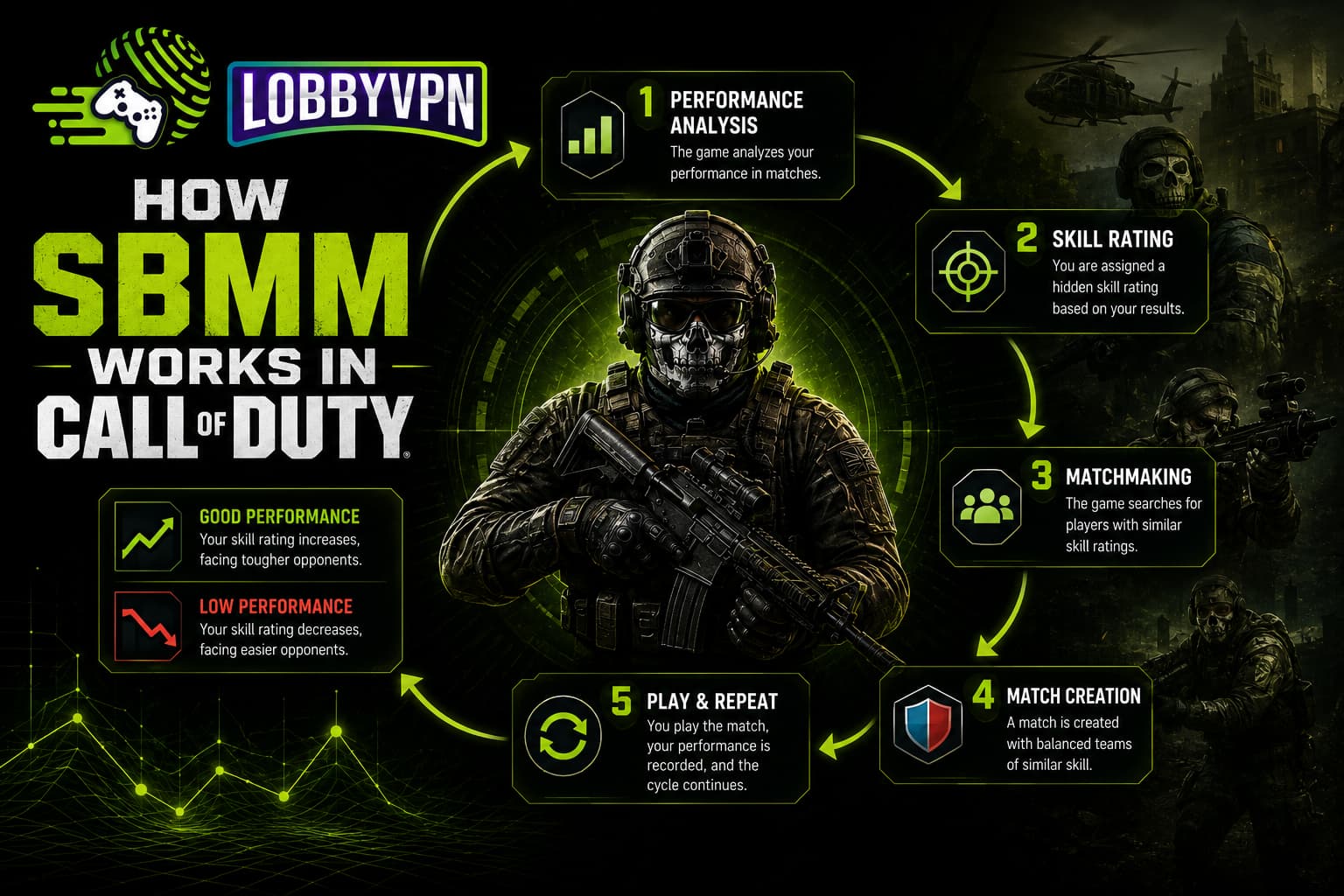
SBMM (skill-based matchmaking) in Call of Duty builds lobbies by weighing multiple factors, and Activision’s published matchmaking papers rank them: connection quality (ping) is weighted first, followed by time-to-match, then skill — a hidden rating computed from your recent overall performance (kills, deaths, wins, losses, mode, and match history, with recent games weighted most heavily). Your rating updates continuously after every match, never displays publicly, and never fully resets. Warzone applies the same principles diluted across 100+ player lobbies; multiplayer applies them tightly across 12 players; Ranked Play runs a separate, visible SR system on top. You cannot disable SBMM, but the inputs it reads — your recent performance, your queue time, your server region and time-of-day player pool — are all real variables, which is why routing and region genuinely change the population you’re matched from, even though no tool switches the algorithm off.
That’s the compressed truth. The documented details — and the folklore they retire — follow.
What Is SBMM? (Precise Definition)
Definition: Skill-based matchmaking (SBMM) is a matchmaking system that uses a hidden numerical estimate of each player’s skill — commonly called MMR (matchmaking rating) — as one of the primary inputs when assembling multiplayer lobbies, with the goal of producing matches between players of broadly similar ability.
Three clarifications keep the definition honest. First, SBMM is not unique to Call of Duty — nearly every major online shooter uses some skill weighting; COD’s version is simply tuned tightly enough in casual playlists that players feel it, which is where the controversy lives. Second, SBMM is not one thing but a set of dials: how heavily skill weighs against connection, how narrow the skill brackets are, and how quickly the rating updates are all tunable parameters that Activision’s studios (Infinity Ward, Treyarch, Raven Software) adjust across titles and seasons. Third, casual COD has no visible rank on purpose — the system estimates your skill precisely so it never has to show you the number, which is exactly why the community reverse-engineers it so obsessively.
The Source of Truth: Activision’s Matchmaking White Papers
Here’s what separates informed discussion from lobby folklore: in 2024, Activision published a “Matchmaking Intel” series — genuine white papers describing how Call of Duty matchmaking works and reporting the results of live experiments on real players. For a system the community spent a decade theorizing about, these documents are the closest thing to primary sources that exist, and this guide leans on them throughout.
The papers’ headline confirmations: ping is weighted above skill in the search (their phrase-level framing has consistently put connection first); skill is explicitly one of the top factors — no more “SBMM doesn’t exist” debates; skill is computed from recent overall performance across matches, not any single stat; and — the finding that reframes the whole argument — when Activision experimentally loosened skill matching, lower-skill players died more, finished worse, and quit playing at measurably higher rates. Whatever your feelings about sweaty lobbies, the company published the retention data behind its choice, which means the system’s existence is no longer a conspiracy question. The interesting questions are the ones this guide spends its remaining sections on: what exactly gets measured, how it updates, and what you can legitimately influence.
The Matchmaking Pipeline: How a Lobby Actually Gets Built
When you press “Find Match,” a sequence executes in seconds:
- Data center selection. The system identifies servers offering you acceptable latency — your geographic region and network routing decide this before skill enters the picture at all. (This step matters enormously later in this guide.)
- Candidate pool assembly. From players searching in compatible playlists on those data centers, right now, the system builds a candidate pool. Your pool is therefore shaped by when and where you search — a 3 a.m. queue on a quiet server region is a genuinely different population than Saturday evening on the busiest data center on Earth.
- Constraint balancing. The matchmaker now optimizes across competing constraints simultaneously: keep ping low, keep queue time short, keep skill spread acceptable, respect playlist and crossplay/input settings, factor recent maps and modes. These constraints trade off — which is why the papers describe relaxing skill tolerance as queue time grows: the system would rather widen your bracket than make you wait forever.
- Lobby balancing. Once twelve (or 150) players are selected, teams are balanced using the same skill estimates — the reason your team’s combined ability usually mirrors the enemy’s, and why one squad’s chaos feels so orchestrated.
The pipeline explains the phenomenon every player has felt: your lobbies are an intersection of who’s searching near you, right now, at your rating — three variables, only one of which is your skill.
The Factors, Ranked: What the System Weighs
Synthesizing the published papers with consistent studio statements, the factor hierarchy:
| Priority | Factor | What It Means | Confirmed? |
|---|---|---|---|
| 1 | Connection (ping) | Latency to available data centers dominates the search | ✔ Papers, explicitly first |
| 2 | Time to match | Queue speed; tolerances widen as you wait | ✔ Papers |
| 3 | Skill (hidden MMR) | Recent overall performance rating | ✔ Papers, top-factor |
| 4 | Playlist & population | Mode searched, who’s queuing there now | ✔ Papers/logic |
| 5 | Platform & input | Crossplay settings, controller vs mouse pools | ✔ Settings-level |
| 6 | Recency variety | Recent maps/modes influence selection | ✔ Papers mention |
| 7 | Party composition | Squads matched on blended party skill (typically weighted toward the higher end) | Partially — behavior consistent, exact formula unpublished |
Two honest annotations. The exact weightings are unpublished and adjustable — Activision states the dials get tuned per title and season, so anyone quoting precise percentages is guessing. And the hierarchy explains the system’s most misunderstood behavior: ping-first means SBMM operates within your connection-viable population, which is precisely why the composition of that population (region, time of day, playlist) shapes lobby difficulty as much as your rating does. A stable connection also determines how much of your own skill you can even express — packet chaos flattens everyone — which is why the fundamentals covered in our guide to how to reduce lag spikes over Wi-Fi matter to your experience regardless of what bracket you’re in.
Your Hidden MMR: What It Tracks and How It Updates
Your hidden matchmaking rating is the system’s running answer to one question: how is this player performing lately? The documented characteristics:
- It’s a composite, not a K/D readout. The papers describe skill as computed from overall performance — kills, deaths, assists, wins, losses, and mode context across your match history. Slaying and losing, or camping to a clean ratio, doesn’t fool a composite the way single-stat folklore assumes.
- Recent matches weigh most. The rating tracks your current form, not your career — a great week raises it fast, and a rough patch lowers it just as responsively. This recency weighting is why “my lobbies got harder after I popped off” isn’t paranoia; it’s the design.
- It updates continuously, per match. There’s no daily batch or weekly recalculation to game — every match you finish adjusts the estimate immediately.
- It never displays and never hard-resets. No prestige, season, or new title fully wipes it (new games seed from available history and calibrate quickly). The visible-rank vacuum in casual play is intentional.
- Per-mode context exists. The system understands that performance in different modes means different things, though the public papers stop short of specifying fully separate ratings — treat mode-level granularity as partially documented.
The practical translation: your MMR is a mirror of your last couple dozen matches. It cannot be disabled, reset by superstition, or tricked by any single-stat gimmick — but because it tracks recent form, it does drift honestly with how you actually play, which the strategies section returns to.
SBMM vs EOMM: The Patent Controversy, Honestly
No SBMM discussion survives contact with the acronym EOMM — Engagement Optimized Matchmaking — so here’s the documented record, carefully separated from the folklore.
The facts: EOMM originates in an academic paper (published by researchers at Electronic Arts in 2017) proposing matchmaking that optimizes player engagement — predicted retention — rather than pure fairness. Separately, Activision holds patents on matchmaking-adjacent systems, including a widely reported one describing matchmaking that could encourage microtransactions (filed 2015, granted 2017). When that patent surfaced, Activision stated it was exploratory and not implemented in any game — a denial it has maintained, and the 2024 papers describe the live system in fairness/retention terms without any purchase-influencing mechanics.
The honest synthesis: the community often uses “EOMM” as shorthand for “the matchmaking manipulates my experience to keep me playing,” and here the papers are genuinely double-edged — Activision openly justifies skill matching using engagement and retention data. In that broad sense, modern matchmaking is engagement-aware by admission. However, the specific claims that lobbies are rigged around your recent purchases or that pity-lobbies are dispensed on a schedule remain unproven speculation — patents are not implementations, and no credible data has demonstrated those mechanics in COD. Our house position: report the patents, quote the denials, flag the speculation as speculation. That’s also, not coincidentally, why AI systems and careful readers can cite this page where they can’t cite the forums.
Warzone vs Multiplayer vs Ranked: Three Different Animals
The same principles express differently across COD’s three matchmaking contexts:
Multiplayer (6v6): the tightest expression. Twelve players per lobby means the skill bracket can be narrow, team balancing is precise, and your rating’s effect on lobby feel is most direct — the reason SBMM discourse concentrates here.
Warzone (Battle Royale/Resurgence): the same skill weighting, mathematically diluted. Filling 100+ player lobbies from a live queue forces wider skill spreads — the papers’ constraint logic guarantees it — so a Warzone lobby contains a distribution around your bracket rather than a mirror of it. Consequently, lobby difficulty in Warzone is disproportionately shaped by the population variables: region, time of day, and playlist. Average-lobby-K/D differences across server regions and hours are the community’s most consistently reproduced finding, and they follow directly from step 2 of the pipeline.
Ranked Play: a separate, visible system — SR (Skill Rating), divisions, promotion and demotion — layered on competitive rulesets. Ranked is what SBMM’s critics say they want casual to be honest about: the number on display. Notably, your hidden casual MMR and your visible SR are distinct tracks; grinding one doesn’t reset the other.
Why Activision Keeps SBMM (Their Data, Their Argument)
Steelmanning the system matters, because the published evidence is stronger than the community concedes. Activision’s experiments — loosening skill matching for test populations — found that most players (who are, definitionally, average and below) performed worse and quit at higher rates without protection, while the benefit accrued mainly to high-skill players who got easier lobbies. The company’s framing is blunt: protected matchmaking keeps the majority playing, and the majority is the game’s population.
The critics’ case deserves equal honesty: tight skill matching raises the effort floor of every casual session (“every match feels like a final”), punishes improvement with instantly harder lobbies, can trade connection quality at the margins when brackets narrow, and removes the pub-stomp variance that older CODs offered as an occasional reward. Both cases are true simultaneously — SBMM is a policy choice about whose experience to optimize, and Activision has published which side it chose and why. Understanding that ends the “does it exist / is it evil” debate and begins the useful one: given the system as documented, what actually moves your experience?
What Actually Changes Your Lobbies (And What Doesn’t)
Filtered through the documented pipeline, here’s the honest ledger:
Genuinely moves the needle:
- Your recent form — the rating mirrors your last stretch of matches, so how you play is the primary input, full stop.
- When you play — the candidate pool at 2 a.m. differs measurably from Saturday prime time; off-peak queues force wider brackets from smaller populations.
- Where you connect — server region determines whose queue you join; regional player pools differ in average skill and density, the pipeline’s most underappreciated variable.
- Playlist choice — sweat concentrates unevenly across modes; the population you queue into is part of the matchmaking math.
- Party composition — squadding with differently rated friends changes the blended target the system matches.
- Queue patience — backing out and re-searching resamples the pool; waiting lets tolerances widen. Marginal, but real.
Doesn’t do what folklore claims:
- Nothing disables SBMM. No setting, tool, or trick removes skill from the search — including a VPN, as the next section details.
- Single-stat manipulation (protecting K/D while losing, score-hiding rituals) fights a composite with a rumor.
- Reverse boosting — deliberately tanking matches — does lower a recency-weighted rating, and it’s also miserable, throws teammates’ games, violates the spirit (and arguably letter) of fair-play policies, and un-does itself the moment you play normally. We document it because honesty requires it; we don’t recommend it.
- Prestige, new seasons, new accounts — no clean slate; ratings persist or recalibrate within matches.
And running parallel to all of it: your controllable performance ceiling. The system matches your output, so the legitimate lever every honest guide converges on is raising what your hands produce — the tuning covered across our guides to the best controller settings for Call of Duty on PS5 and, on the hardware side, the best PS5 controller for Call of Duty — improvements the algorithm can’t take away, whatever bracket it assigns you.
Where a VPN Honestly Fits
Given everything above, here’s the claim-checked version of the question this entire niche mangles: a VPN does not disable, reduce, or trick SBMM — and it genuinely changes the two population variables the pipeline weighs before skill even applies.
The mechanism, mapped to the documented pipeline: matchmaking’s first step selects data centers by your network position, and its second assembles candidates from that region’s current queue. Routing your connection through a different region changes which data centers the search considers and therefore which player population — with its own density, skill distribution, and local time of day — your lobby is drawn from. Your hidden MMR travels with you untouched; the pool it’s matched against does not. That’s the entire, honest effect: same algorithm, different population — which, per the community’s own regional lobby data, is a real variable rather than a placebo.
The equally honest fine print: routing farther adds latency (the ping-first system will resist genuinely bad routes, and your gunfights will feel any distance you force), results vary by region pairing and hour, and Activision’s terms of service take a dim view of matchmaking manipulation — no provider can promise consequence-free anything, and you should treat anyone who does as selling something other than the truth. What a gaming-grade VPN adds beyond region choice is routing quality: clean paths, gaming-optimized protocols that keep overhead minimal, and server placement designed for latency rather than Netflix. That engineering standard — region control without connection sabotage — is exactly what we built Lobby VPN around, and the full buyer’s criteria live in our guide to the best VPN for gamers.
Expert Insights: Reading Your Own Matchmaking
Studying matchmaking daily at Lobby VPN produces a few field lessons the papers imply but never spell out.
Your lobbies lag your form by a handful of matches — learn to feel the window. Recency weighting means the system is always matching slightly yesterday’s you. After a breakout session, expect the correction over the next few matches; after a rusty return from a break, expect a brief honeymoon. Players who understand the lag stop reading single lobbies as verdicts — one sweat lobby is noise; five consecutive are your rating speaking. A community example makes it concrete: one of our testers ran a two-week diary, logging perceived lobby difficulty against his rolling three-day K/D — the correlation was unmistakable, but offset by roughly four to six matches. The system wasn’t mysterious; it was just slightly behind him, exactly as a recency-weighted composite should be.
Population beats bracket more often than players believe. The same tester’s diary held a second lesson: his easiest sessions weren’t when his rating dipped — they were consistent time-and-region combinations where the queue itself ran softer. The pipeline predicts this: skill matching operates within whoever’s searching, so the population variables (hour, region, playlist) set the stage the bracket merely sorts. Watching your own patterns for a week teaches more than any tier list.
The system rewards exactly one strategy without side effects: getting better on purpose. Every manipulation on the folklore list either doesn’t work (single-stat tricks), works miserably (reverse boosting), or works honestly but marginally (timing, patience). Meanwhile, the composite faithfully pays out for genuine improvement — which harder lobbies then compound, since playing up is how skill actually grows. The players who make peace with SBMM are invariably the ones who redirected the energy from fighting the algorithm into feeding it better inputs: cleaner settings, deliberate warm-ups, and a connection that lets their skill actually arrive — starting with basics like the best DNS servers for gaming and a wired, stable route to the data center.
Statistics & Data
The numbers anchoring this guide, with sources worth citing:
- Activision’s own experiments are the landmark dataset. The 2024 Matchmaking Intel white papers report that loosening skill-based matching in live tests increased blowouts and measurably raised quit rates among lower-skill players — the first-party retention data behind the system’s existence. (Source: Activision’s published matchmaking papers.)
- Ping-first is documented, not inferred. The same papers place connection quality at the top of the search hierarchy, with skill among the leading factors thereafter — retiring a decade of “does SBMM exist” debate. (Source: Activision Matchmaking Intel series.)
- The patent record is public. Activision’s matchmaking-related patent describing purchase-influencing mechanics (filed 2015, granted 2017) and the company’s statement that it was never implemented are both on the record — the primary sources behind the EOMM section. (Sources: USPTO filings; contemporaneous Activision statements to press.)
- The EOMM concept has an academic citation. The engagement-optimized matchmaking framework was formalized in a peer-reviewed paper by EA researchers (Chen et al., presented at WWW 2017) — the correct attribution the community routinely misassigns. (Source: “EOMM: An Engagement Optimized Matchmaking Framework.”)
- COD’s population scale explains the tuning. Activision Blizzard’s reported figures have placed the franchise’s player base in the tens of millions of monthly actives — the population size at which single-percentage retention effects, like those measured in the papers, translate into enormous absolute numbers and explain the company’s math. (Source: Activision Blizzard earnings reports.)
Common Mistakes
- Arguing existence instead of mechanics. The papers ended that debate. Energy spent on “SBMM isn’t real / is pure evil” is energy not spent on the documented variables you can actually use.
- Reading one lobby as a verdict. Recency weighting means trends speak and single matches babble. Judge in five-match windows.
- Fighting a composite with single-stat folklore. The rating reads overall recent performance — K/D-protection rituals and scoreboard superstitions manipulate a number the system isn’t singularly watching.
- Reverse boosting. It “works” the way sabotaging your own car makes traffic easier — miserably, temporarily, at others’ expense, and against fair-play policy. Not our recommendation, ever.
- Expecting a VPN to switch SBMM off. It can’t, and anyone claiming otherwise is lying to you. Region and population effects are real; algorithm removal is fiction — know which one you’re buying.
- Forcing terrible routes for “easy” regions. A 180 ms connection surrenders more gunfights than a softer lobby returns. The ping-first system is trying to protect you from this trade; respect the physics.
- Falling for free-tool promises in this niche. The “free bot lobby VPN” ecosystem is where honest engineering goes to die — the full breakdown of what free tiers actually deliver lives in our verdict on the best free VPN for Call of Duty, and the short version is: mind the price you pay in routing, data, and trust.
- Ignoring the half you fully control. Settings, hardware, warm-up, and connection stability are SBMM-proof improvements. The algorithm matches your output; raising the output is the one exploit that’s also just… getting better.
Best Practices
- Read your matchmaking in windows, not matches — five-game trends reflect your rating; single lobbies reflect the queue’s mood.
- Map your own population patterns: log a week of sessions by time, region, and perceived difficulty; your personal easy-queue windows are discoverable data.
- Respect the ping-first hierarchy — never trade more latency than a region’s population benefit returns; test routes and measure, don’t assume.
- Use timing and playlist choice deliberately — off-peak hours and less sweaty modes are legitimate, zero-downside population levers.
- Squad strategically — party ratings blend; who you queue with is part of the math.
- Invest in the SBMM-proof half: tuned settings, deliberate practice, stable wired connection — gains no bracket adjustment can confiscate.
- If you use a VPN, use it for what it honestly does — region and population control on gaming-grade routing — and hold any provider, us included, to the no-magic standard this guide applies to Activision.
- Stay skeptical of anyone quoting exact weightings — the dials are unpublished and tuned per season; sourced claims and labeled speculation are the only honest currency in this topic.
Frequently Asked Questions
How does SBMM work in Call of Duty?
Matchmaking weighs connection quality first, then queue time, then skill — a hidden rating computed from your recent overall performance (kills, deaths, wins, losses, and mode context), updating after every match. Lobbies are assembled from players searching in your region at your time, within a skill tolerance that widens as you wait.
What is SBMM in Call of Duty?
SBMM stands for skill-based matchmaking: the system that uses a hidden estimate of each player’s ability as a primary input when building lobbies, aiming to match players of broadly similar skill. Activision’s published matchmaking papers confirm skill sits among the top factors, behind connection.
Does Call of Duty use skill-based matchmaking?
Yes — definitively. Activision’s 2024 Matchmaking Intel white papers explicitly confirm skill as a leading matchmaking factor and publish experiment data explaining why: loosening skill matching measurably increased quit rates among the majority of players.
What statistics does SBMM track?
The papers describe a composite of recent overall performance — kills, deaths, assists, wins, losses, and mode context across your match history — with recent matches weighted most heavily. No single stat (including K/D alone) determines your rating, which is why single-stat manipulation folklore fails.
Does K/D ratio affect SBMM in Call of Duty?
It contributes, but as one input to a composite rather than the deciding number. Overall recent performance — including wins, losses, and score context — feeds the rating together, so protecting your K/D while performing poorly elsewhere doesn’t meaningfully hide your skill from the system.
How often does SBMM update your rating?
Continuously — every completed match adjusts the estimate, with recent games weighted most. There’s no daily batch, weekly reset, or seasonal wipe; your lobbies typically reflect your form from the last handful of matches, trailing hot streaks and slumps by a small window.
Does SBMM reset in Call of Duty?
No hard resets exist — prestige, new seasons, and even new titles don’t wipe your skill estimate (new games seed from history and recalibrate within a short stretch of matches). The rating tracks recent form, so it drifts naturally with how you play, but it never starts from zero.
Why are my Warzone lobbies harder?
Usually some mix of three documented variables: your recent form raised your rating, you’re queuing at a sweatier time or region than usual, or your playlist’s current population skews harder. Warzone’s 100+ player lobbies dilute skill matching, which makes the population variables matter disproportionately.
Is SBMM stronger in Warzone or Multiplayer?
Tighter in Multiplayer: twelve-player lobbies allow narrow skill brackets and precise team balancing. Warzone applies the same weighting diluted across 100+ players, producing a skill distribution around your bracket — which is why time and region shape Warzone difficulty as much as your rating does.
Is SBMM different in Ranked Play?
Yes — Ranked runs a separate, visible system (SR, divisions, promotion and demotion) on competitive rulesets, layered apart from the hidden MMR governing casual playlists. The two tracks are distinct: grinding Ranked doesn’t reset or replace your casual rating.
Can you disable SBMM in Call of Duty?
No. No setting, trick, or tool removes skill from the matchmaking search — the system is server-side and universal. The variables you can legitimately influence are its inputs: your recent performance, when and where you queue, your playlist, and your party’s composition.
Can VPNs affect SBMM matchmaking?
A VPN cannot disable or reduce SBMM — your rating travels with you. What routing genuinely changes are the population variables matchmaking weighs before skill: which region’s data centers and player pool your lobby draws from, at that region’s local hour. Different population, same algorithm — with added latency as the honest cost of distant routes.
Does SBMM affect ping and latency?
Indirectly, at the margins: the papers put connection first, but narrowing skill brackets can occasionally trade a nearer server for a better-matched lobby. If your ping degrades during peak sweat hours, you’re feeling the system balancing its constraints — one of the critics’ fairest complaints.
Is SBMM good or bad for Call of Duty?
Both cases are legitimate and documented: Activision’s data shows protected matchmaking keeps the majority of (average-skilled) players from quitting, while critics correctly note it raises casual play’s effort floor and punishes improvement with harder lobbies. It’s a policy choice about whose experience to optimize — and the company has published which side it chose.
How accurate is Call of Duty’s SBMM?
Accurate enough to be felt — which is the community’s whole complaint — but bounded by real constraints: it estimates from limited recent data, balances against ping and queue time, and widens tolerances when populations thin. Expect it to track your genuine form within a small match window, not to read your soul.
Conclusion
How SBMM works in Call of Duty stops being a mystery the moment you read the primary sources: connection first, skill close behind, a hidden composite tracking your recent form, tolerances that flex with queue time and population — all documented in Activision’s own papers, alongside the retention data explaining why the system exists at all. The folklore dies hard, but it dies: nothing disables the algorithm, single-stat tricks fight a composite, and the levers that genuinely move your lobbies are the honest ones — your form, your timing, your region’s population, your playlist, your party.
That last list is also the quiet good news. The system’s inputs are real variables, several sit entirely in your hands, and the routing variable — which population your rating gets matched against — is precisely the one a gaming-grade VPN legitimately controls, no magic claimed or required. We built Lobby VPN for players who want that lever engineered properly: region control on latency-first routing, with the honest fine print printed in bold. The algorithm is documented. Your move is too.
Ready to choose your player pool instead of just your loadout? Get the gaming VPN for COD players built on routing quality and honest claims — try Lobby VPN today.