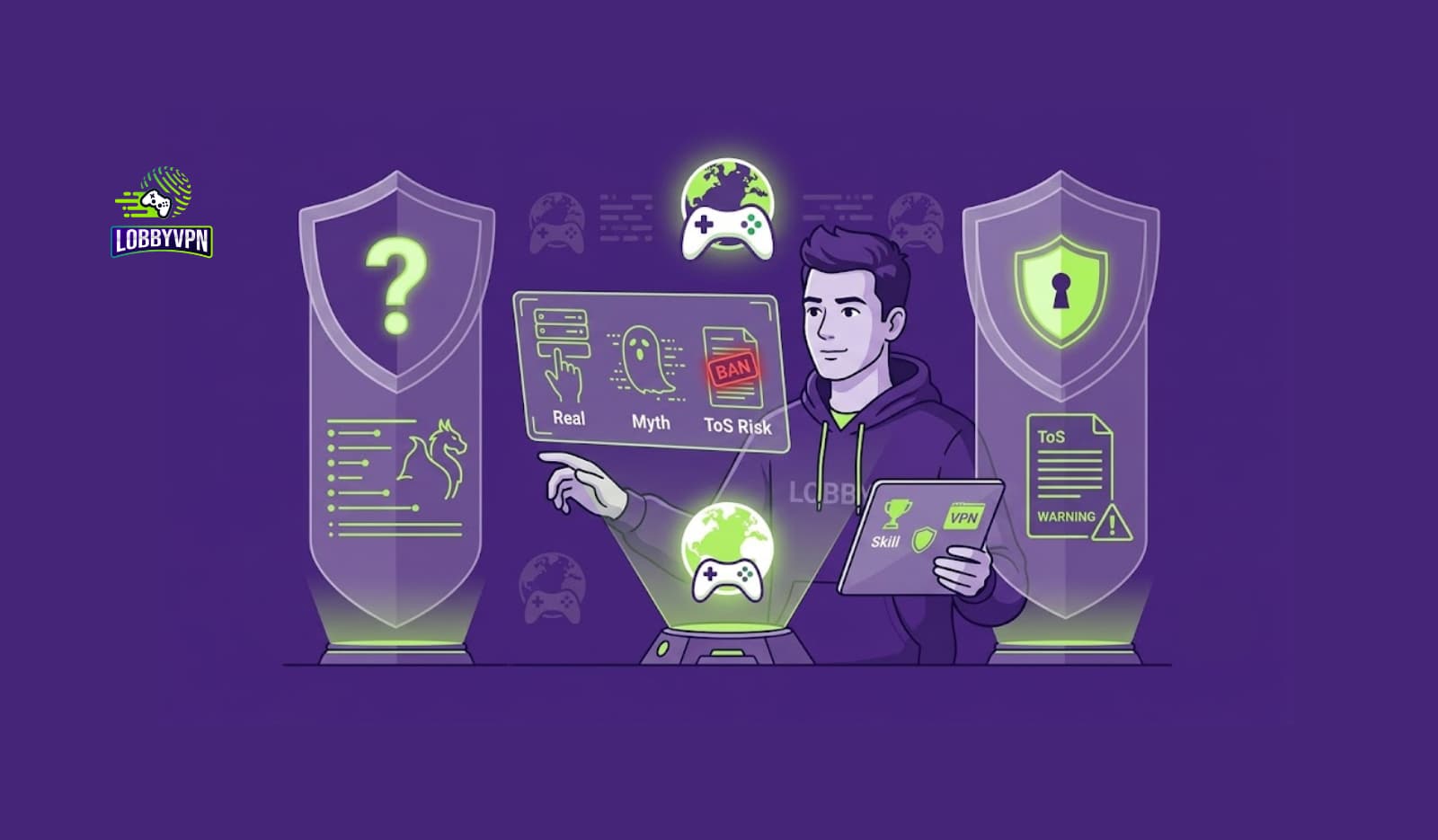
The SBMM/VPN Debate: What’s Real, Myth, and ToS Risk
Two players load into Warzone on the same night. One drops 23 kills against lobbies that seem allergic to aiming; the other gets hunted by a four-stack of demons the moment his boots hit Verdansk. Same game, same skill level — and the first one swears his VPN is the reason.
Welcome to the SBMM/VPN debate, the longest-running argument in competitive Call of Duty. One camp insists a VPN unlocks “bot lobbies” on demand. Another calls the whole thing placebo wrapped in a subscription. Meanwhile, Activision has published actual matchmaking white papers, anti-cheat teams have commented on manipulation, and thousands of Reddit threads have buried the truth under anecdotes pointing in every direction at once.
Someone should separate the claims into three honest piles — what’s real, what’s myth, and what carries genuine terms-of-service risk — using published data instead of killcam vibes. That is this article.
Our team at Lobby VPN sits in an awkward and useful position for this debate: we sell gaming VPNs, which means we profit when players believe the hype — and lose those players in a month when the hype fails them. Honesty is our retention strategy. So here is the full picture: how skill-based matchmaking actually works, the mechanism behind the VPN theory, where it holds up, where it collapses, what Activision’s own research says, and what a gaming VPN is genuinely worth buying for.
Table of Contents
- Skill-Based Matchmaking, Actually Explained
- Why the SBMM Controversy Exists at All
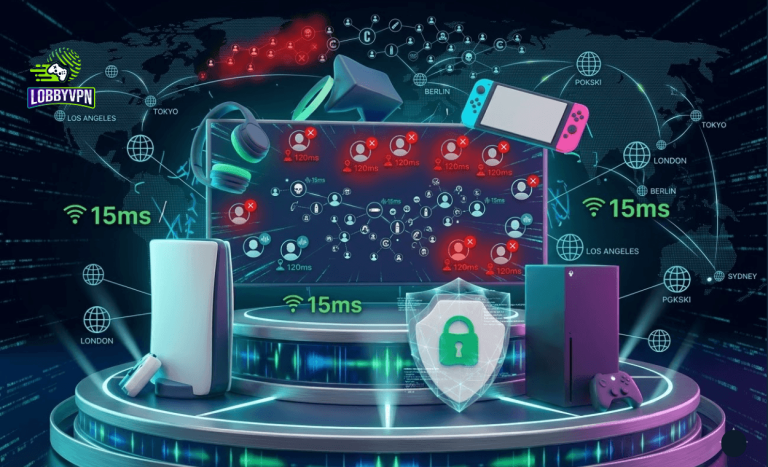
- The Theory: How a VPN Is Supposed to Affect SBMM
- What’s Real: The Claims That Survive Scrutiny
- What’s Myth: The Claims That Don’t
- What’s ToS Risk: The Honest Legal Layer
- The Trade-Off Nobody Advertises: Lobby Difficulty vs Ping
- SBMM and VPNs Across Games: COD, Fortnite, Apex, Valorant
- What a Gaming VPN Is Actually Worth Buying For
- Should You Use One? A Decision Framework
- Expert Insights from the Lobby VPN Team
- Statistics and Data: What the Research Shows
- Common Mistakes in the SBMM/VPN Conversation
- Best Practices for Better Lobbies (Legitimately)
- Frequently Asked Questions
- Conclusion and Key Takeaways
Skill-Based Matchmaking, Actually Explained
Skill-based matchmaking (SBMM) is a system that sorts players into lobbies using hidden performance metrics — recent kills, deaths, score per minute, win rates — alongside connection quality and queue time. The matchmaker balances three competing goals: fast matches, low ping, and skill-appropriate opponents, tightening or loosening skill brackets depending on how many players are available in your region at that moment.
Three details from that definition drive the entire debate.
Skill is one input among several. Activision’s published matchmaking papers describe a weighted system: connection quality (ping) historically leads, then time-to-match, then skill and other factors. The matchmaker is a negotiator, not a judge — it trades between priorities constantly.
Player pool size changes everything. A huge pool (US East, 8 p.m.) lets the matchmaker be picky, building tight skill brackets fast. A thin pool (small region, 4 a.m.) forces the same algorithm to widen brackets or make you wait. This single mechanic — bracket elasticity under pool pressure — is the real engine behind every VPN theory you have ever read.
The metrics are account-level, not connection-level. Your performance history rides on your Activision account across every session, device, and network. Changing your apparent location changes which pool you queue into; it does not amnesia-wipe the profile the matchmaker consults.
Hold those three facts. Every “real vs myth” verdict below flows from them.
Why the SBMM Controversy Exists at All
The SBMM controversy is not really about matchmaking algorithms. It is about who the game is for.
Publishers tune matchmaking as a player retention system. Activision’s own research — published in its 2024 matchmaking series — described experiments where loosening skill matching caused lower-skilled players (the majority of any player base) to die more, play less, and quit faster. Tight skill brackets protect the newest and weakest players, which protects the population, which protects everyone’s queue times. From a player experience design standpoint, the logic is coherent.
Above-average players experience the same system as a treadmill. Improve, and your lobbies improve with you; every session feels like a final. The “pub stomp” — relaxing against weaker opponents after a long day — quietly disappeared from unranked play, and a generation of players who remembered connection-based matchmaking noticed. Streamers amplified the frustration: their content depends on highlight reels, and highlight reels are hard to farm inside a bracket of mirror-image sweats.
Layer in opacity — no visible rank in unranked modes, no published bracket criteria, patch-to-patch tuning nobody announces — and you get the perfect conditions for folk theories. The VPN theory is simply the most durable of them, because unlike most folk theories, it contains a real mechanism. Which brings us to the theory itself.
The Theory: How a VPN Is Supposed to Affect SBMM
Strip the YouTube thumbnails away and the VPN-for-easier-lobbies theory rests on one legitimate observation about matchmaking algorithms: bracket elasticity.
The chain of reasoning runs like this. A VPN routes your traffic through a server elsewhere, changing your apparent location and therefore which regional player pool you queue into. Queue into a pool that is small or off-peak, and the matchmaker faces a choice: make you wait, stretch the acceptable ping range, or widen the skill bracket to fill the lobby. Widened brackets mean a mix of skill levels instead of a tight band of your clones — which above-average players experience as “easier lobbies.”
Notice what the theory does not claim, when stated honestly. It does not claim the VPN disables SBMM — the system runs identically everywhere. It does not claim you queue against bots — you queue against a wider human skill spread. And it does not claim consistency — pool sizes shift by hour, region, and season, so the same trick produces different results on different nights.
Stated that carefully, the theory is mechanically plausible. Whether it survives contact with 2026’s matchmaking reality — and at what cost in ping — is exactly what the next three sections sort out.
What’s Real: The Claims That Survive Scrutiny
Grading honestly, four claims hold up.
Real: player pool size affects bracket width. This is straightforwardly how online matchmaking systems work, and Activision’s own papers acknowledge the tension between queue time, ping, and skill tightness. Thin pools force looser matches — with or without a VPN. Playing at off-peak local hours produces a version of the same effect for free.
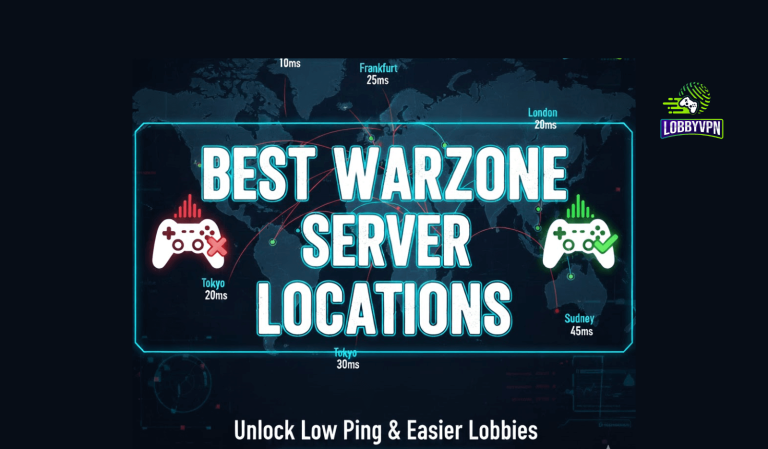
Real: a VPN changes which pool you queue into. Regional matchmaking keys substantially off your network route, so tunneling to another region genuinely shifts your queue. The mechanism exists; the outcome is where myths creep in.
Real: some players, some of the time, observe softer lobbies. The effect is inconsistent by design — dependent on target-region pool size, time of day, and current matchmaking tuning — but calling every report placebo overcorrects. Variance is the honest description: a lever that sometimes moves, attached to a machine that keeps being re-tuned.
Real: routing changes can genuinely improve your connection. Separately from any matchmaking effect, a well-peered tunnel can route around ISP congestion and reduce ping or jitter — the measurable, repeatable benefit that survives every patch. The protocol layer matters enormously here, which is why our guide to the best VPN protocols for gaming is the companion piece to this one: WireGuard-class tunnels add 2–5 ms of overhead, while sloppy configurations add ten times that and erase every other advantage.
What’s Myth: The Claims That Don’t
Five popular claims collapse under inspection.
Myth: “A VPN turns off SBMM.” Nothing turns it off. The algorithm runs identically in every region and every pool; what changes is the raw material it has to work with. Players who expect the system disabled are buying a lever and expecting a kill switch.
Myth: “Guaranteed bot lobbies.” No tunnel manufactures beginners on demand. Thin-pool lobbies still contain the full human range — including, occasionally, the exact demons you were fleeing, because they read the same Reddit threads you did. Anyone promising guaranteed lobby difficulty is selling variance as certainty, and churning customers a month later.
Myth: “Matchmaking only sees your IP.” Your skill metrics live on your Activision account, not your connection. Geo-shifting changes the pool, never the profile — the matchmaker still knows exactly who you are within whatever pool it finds you.
Myth: “It works the same as it did in 2021.” Publishers tune these systems constantly, and multiple Warzone updates have specifically targeted matchmaking manipulation. Techniques that visibly worked in one season quietly stopped in another; evergreen “bot lobby methods” are archaeology sold as strategy.
Myth: “There’s no downside.” Every region-shift is paid for in milliseconds. Tunneling to a distant, thin pool can add 60–120 ms — and as our companion analysis of the lobby-difficulty trade-off shows below, a slightly easier lobby at 140 ping routinely plays worse than a fair one at 30. The invoice for the myth arrives in every gunfight.
What’s ToS Risk: The Honest Legal Layer
Here is the section most VPN marketing conveniently forgets, delivered straight.
Using a VPN is not itself banned. Millions of players tunnel for security, travel, ISP throttling, and DDoS protection; Activision, Epic Games, Riot Games, and Respawn Entertainment all serve enormous VPN-using populations without issue. No major publisher prohibits the technology as such.
Manipulating matchmaking is a different category. Publisher terms of service and security policies broadly reserve the right to act against exploiting or manipulating game systems — and deliberately gaming the matchmaker sits inside that language. Activision’s RICOCHET anti-cheat communications have explicitly targeted matchmaking manipulation alongside cheating tools, and Warzone updates have shipped countermeasures aimed at exactly this behavior.
Enforcement reality, stated plainly. Documented bans for VPN use alone are rare to the point of anecdote; publishers generally respond to manipulation with soft countermeasures — routing you by account data, tightening pool logic — rather than ban waves against tunnels. Still, three honest caveats belong on the record. Enforcement policies change without notice, and past leniency guarantees nothing. Accounts flagged for pattern behavior (constant region-hopping paired with statistical anomalies) invite scrutiny no ordinary VPN user attracts. And shady “bot lobby services” that pair VPNs with account tools or lobby software cross into plainly bannable territory — a category no reputable provider will touch.
Our position at Lobby VPN is the same one we give this article: we build tunnels for routing, stability, privacy, and protection. Those uses are unambiguous. Players who geo-shift for matchmaking reasons should do it informed — knowing the mechanism is inconsistent, the ping cost is real, and the ToS gray zone is theirs to own, not ours to wave away.
The Trade-Off Nobody Advertises: Lobby Difficulty vs Ping
Every region-shift trades competitive fairness in one currency for competitive handicap in another. Put numbers on it:
| Scenario | Typical Ping | Lobby Skill Spread | How It Actually Plays |
|---|---|---|---|
| Home region, peak hours | 20–40 ms | Tight (your bracket) | Fair fights, crisp hitreg — the sweat you know |
| Home region, off-peak (no VPN) | 20–40 ms | Moderately widened | Softer mix, zero ping cost — the free version of the trick |
| Nearby foreign region via VPN | 50–90 ms | Somewhat widened | Mixed lobbies, noticeable delay on peeks |
| Distant thin-pool region via VPN | 100–160+ ms | Widest | “Easier” opponents you now can’t out-gun — delayed shots, ghost bullets, lost trades |
The bottom row is where bot-lobby dreams go to die. At 140 ms, you see every opponent late, your shots register late, and the interpolation gymnastics that make high-ping play survivable also make it feel like fighting underwater. Above-average players routinely post worse stats in “easier” distant lobbies than in fair local ones — the handicap outweighs the discount.
Two better plays fall out of the table. First, the off-peak row: playing your own region at quieter hours captures most of the bracket-widening effect at zero ping cost, no tunnel required. Second, whatever your matchmaking philosophy, fix the connection fundamentals before touching geography — wired beats wireless every time, and players still gaming over a flaky router should start with our guide on how to reduce lag spikes over Wi-Fi, because no lobby is easy through 8 percent packet loss.
SBMM and VPNs Across Games: COD, Fortnite, Apex, Valorant
The debate lives loudest in Call of Duty, but every major shooter runs its own version — and the VPN question lands differently in each.
| Game (Publisher) | Matchmaking System | VPN Sensitivity | Notes |
|---|---|---|---|
| Call of Duty / Warzone (Activision) | Hidden SBMM weighing ping, queue time, skill | Historically the highest — and the most actively countered | Published white papers; RICOCHET targets manipulation; tuning changes per season |
| Fortnite (Epic Games) | SBMM plus bot backfill at lower skill tiers | Lower payoff | Bots already soften low brackets; pool-shifting adds little for skilled players |
| Apex Legends (Respawn Entertainment) | SBMM across casual and ranked | Moderate, inconsistent | Regional data-center selection is built in, reducing the VPN’s unique leverage |
| Valorant (Riot Games) | Visible ranked MMR; strict competitive integrity stance | Lowest — and riskiest | Riot’s systems and Vanguard anti-cheat treat manipulation harshly; don’t |
The pattern across the table: the more visible and competitive the ranking system, the less a VPN can influence it and the more dangerous trying becomes. Unranked COD is the gray zone that spawned the debate; Valorant ranked is the red zone where the debate should never go.
What a Gaming VPN Is Actually Worth Buying For
Strip away the matchmaking mythology and a strong case remains — the boring, durable gaming VPN benefits that survive every patch cycle.
DDoS protection. Ranked grinders and anyone who streams gets IP-harvested and hit with connection floods by sore losers. A tunnel hides your real address behind infrastructure built to absorb the abuse — the single clearest reason competitive players tunnel, covered in depth in our guide to the gaming VPN for COD players.
Routing around ISP congestion. Evening rush hour is real on the internet too: several ISPs push game traffic through congested exchanges at peak times. A well-peered tunnel exits through cleaner routes, and the resulting ping reduction is measurable, repeatable, and matchmaking-independent.
Network stability and throttling. Some ISPs deprioritize or shape UDP game traffic; encryption makes your packets unclassifiable, which ends the shaping. Jitter smoothing through consistent routing helps hit registration more than any lobby trick.
Region selection for legitimate reasons. Traveling players keeping their home region, early access to time-gated content, and scrims with international teammates all use the same geography feature the debate obsesses over — without the gray zone.
Security on the networks gamers actually use. LAN events, hotels, dorms, and tournament Wi-Fi are hostile environments; encryption there is just hygiene.
A tunnel bought for these five reasons pays for itself whatever the matchmaker does. A tunnel bought for bot lobbies gets canceled in a month — we have the churn data to prove it.
Should You Use One? A Decision Framework
Answer three questions honestly.
1. Is your connection already clean? Wired, stable, low jitter, decent ping? If not, fix that first — hardware and habits beat geography. If yes, continue.
2. What are you actually buying? If the answer is DDoS protection, routing, throttling relief, or travel flexibility: a gaming VPN is a straightforward yes, and choosing well matters more than the debate — our breakdown of the best VPN for gamers grades providers on the criteria that survive patches: protocol stack, server peering, published latency data, and absorption infrastructure.
3. If it’s matchmaking — are you informed? Then hold three facts simultaneously: the mechanism is real but inconsistent and actively countered; the ping cost frequently exceeds the lobby discount; and the ToS gray zone is yours to own. Players who proceed anyway should at minimum prefer the free version — off-peak hours in their own region — before paying milliseconds for geography.
That framework, applied honestly, sorts nearly everyone. The players it doesn’t sort are usually looking for permission rather than information — and no article can sell that.
Expert Insights from the Lobby VPN Team
What running a gaming VPN through three years of this debate has taught us:
Insight 1: Bot-lobby buyers churn; routing buyers stay. Our retention data splits cleanly by acquisition promise. Users who arrived through “easier lobbies” content canceled within weeks when variance did what variance does. Users who arrived for DDoS protection and routing renew year after year, because those benefits show up every session. We rebuilt our entire marketing around that split — this article included.
Insight 2: The same trick, the same account, different nights, opposite results. We ran structured tests: identical accounts, identical target regions, identical hours, one week apart. Lobby composition varied wildly — sometimes visibly softer, sometimes indistinguishable, once memorably harder. Pool dynamics and silent tuning changes swamp the technique. Anyone reporting consistent results is reporting a small sample.
Insight 3: Players blame SBMM for what packet loss is doing. A meaningful share of “the matchmaking is rigged” support tickets resolve with connection diagnostics: Wi-Fi interference, evening ISP congestion, one bad hop. The lobby was fair; the connection wasn’t. Fixing jitter changed their experience more than any region ever could — which is why we push network fundamentals before geography, always.
Insight 4: Off-peak local play is the industry’s worst-kept free secret. The bracket-widening everyone pays milliseconds to chase abroad exists at home at 7 a.m. on a Tuesday. Several of our own team members quietly schedule their casual sessions this way — same mechanism, zero ping tax, zero gray zone. The debate would be half its size if this were better known.
Insight 5: Honesty converts better than hype — measurably. When we rewrote our gaming pages to state the matchmaking variance plainly and lead with routing and protection, conversion rose. COD players have been burned by enough thumbnails; being the one vendor that levels with them turned out to be the growth strategy, not the sacrifice.
Statistics and Data: What the Research Shows
Evidence worth citing, sources named:
- Activision’s 2024 matchmaking white paper series documented live experiments: when skill was deprioritized in matchmaking, lower-skilled players — the majority of the population — died more, played less, and returned less, which is the publisher’s stated case for keeping SBMM. (Activision matchmaking papers)
- The same papers rank connection quality (ping) and time-to-match among the leading matchmaking inputs, confirming the bracket-elasticity mechanism the VPN theory depends on — and the ping penalty it ignores. (Activision)
- RICOCHET anti-cheat communications have explicitly listed matchmaking manipulation among targeted behaviors, alongside multiple Warzone updates shipping countermeasures. (Activision RICOCHET progress reports)
- Competitive play lives under 60 ms: ranked and professional COD players target sub-30 ms and treat 100+ as a handicap — the range distant-region tunneling routinely enters. (Esports networking guidance; Activision recommendations)
- Fortnite’s matchmaking backfills lower-skill lobbies with bots (Epic Games), while Valorant publishes visible ranked MMR (Riot Games) — the design spectrum that determines how much any pool-shifting can matter per title. (Publisher documentation)
- Market context: gaming ranks among the fastest-growing use cases inside a 1.75 billion-user global VPN market, which is precisely why the myth economy around it grew so lucrative. (VPNpro; The Business Research Company)
One quotable synthesis: the VPN theory is built on a real matchmaking mechanism, paid for in real milliseconds, countered by real publisher tuning — three truths the debate keeps discussing one at a time.
Common Mistakes in the SBMM/VPN Conversation
- Expecting a kill switch. Nothing disables SBMM; pool-shifting only changes the algorithm’s raw material.
- Buying certainty from variance. “Guaranteed bot lobbies” is a refund request scheduled a month out.
- Ignoring the ping invoice. A 140 ms “easy” lobby plays harder than a 30 ms fair one for most players’ actual results.
- Judging by highlight reels. Streamer footage is a survivorship museum; the off-nights don’t get uploaded.
- Forgetting the account follows you. Skill metrics are account-level; geography changes the pool, never the profile.
- Treating 2021 techniques as evergreen. Publishers tune constantly; last season’s method is this season’s placebo.
- Blaming matchmaking for connection sins. Packet loss and jitter masquerade as “rigged lobbies” daily — diagnose before theorizing.
- Touching third-party lobby services. VPN-plus-account-tools packages sit in plainly bannable territory; no lobby is worth the account.
- Applying COD logic to Valorant. Riot’s visible MMR and Vanguard enforcement make manipulation both futile and genuinely risky.
- Skipping the free version. Off-peak local hours deliver the same bracket-widening without ping cost or gray zone — try Tuesday morning before Cairo.
Best Practices for Better Lobbies (Legitimately)
- Fix the physical layer first: wired connection, clean channel, updated firmware — the foundation every other gain compounds on.
- Tune the tunnel for latency, not geography: WireGuard-class protocols, nearby low-load servers, split tunneling for game traffic only.
- Complete the latency budget: resolver speed matters at login and server selection, and our roundup of the best DNS servers for gaming covers that final slice.
- Benchmark with the game’s own stats: ping, jitter, and packet loss before and after every change — data ends debates that anecdotes started.
- Use off-peak local hours when you want relaxed sessions; it’s the mechanism without the invoice.
- Reserve region selection for its honest uses: travel, international squads, routing around congestion.
- Protect the account you grind on: DDoS-absorbing infrastructure and IP privacy are the tunnel benefits that appreciate over time.
- Re-test after every season patch — matchmaking tuning changes silently, and last month’s observations expire.
Frequently Asked Questions
Does a VPN affect SBMM?
Indirectly, sometimes. A VPN never changes the SBMM algorithm itself — it changes which regional player pool you queue into. Smaller or off-peak pools force the matchmaker to widen skill brackets, which some players experience as easier lobbies, inconsistently and at a ping cost.
Can a VPN bypass SBMM?
No. Skill-based matchmaking runs identically in every region, and your skill metrics live on your account, not your IP address. A VPN can shift the pool the algorithm draws from; it cannot switch the algorithm off or hide your performance history.
Does a VPN reduce SBMM in Call of Duty?
It can loosen effective bracket tightness when it lands you in a thin player pool — the mechanism is real but inconsistent, actively countered by Activision’s tuning, and paid for in added latency that often outweighs the benefit.
Is using a VPN for SBMM cheating?
It occupies a gray zone. VPN use itself is permitted and widespread; deliberately manipulating matchmaking brushes against publisher terms that prohibit exploiting game systems, and Activision’s RICOCHET team has named matchmaking manipulation a targeted behavior. Enforcement against VPN-only users has been rare, but the risk is the player’s to own.
Can you get banned for using a VPN in Warzone?
Documented bans for ordinary VPN use are rare to anecdotal; publishers primarily respond with matchmaking countermeasures rather than account actions. Pairing a VPN with third-party lobby tools or account services is a different story — that territory is plainly bannable.
Why do gamers use VPNs for easier lobbies?
Because the underlying mechanism — thin player pools forcing wider skill brackets — is real, and highlight-reel content made it look reliable. The parts the thumbnails omit: results vary by night and season, the account’s skill profile travels with you, and distant regions charge 60–120 ms for the attempt.
What are “bot lobbies,” really?
In practice, “bot lobbies” just means lobbies with a wider human skill spread than your usual bracket — not lobbies of actual bots (except in Fortnite, where Epic genuinely backfills low tiers with AI). No VPN manufactures beginners on demand.
Does playing at off-peak hours work like a VPN for SBMM?
Largely, yes — and free. Quieter local hours shrink your regional pool, producing the same bracket-widening pressure without added ping or gray-zone questions. It is the version of the trick this debate keeps overlooking.
Do VPNs affect matchmaking in Fortnite, Apex, or Valorant?
Far less than in COD. Fortnite’s bot backfill already softens lower brackets, Apex builds regional server selection into the client, and Valorant’s visible MMR plus Riot’s strict enforcement make manipulation both ineffective and genuinely risky.
Can a VPN improve gaming lobbies in any legitimate way?
Yes — through connection quality rather than matchmaking. Routing around ISP congestion, smoothing jitter, defeating traffic shaping, and blocking DDoS attacks all improve how lobbies play, independent of who is in them.
Will Activision’s SBMM changes kill the VPN trick entirely?
The trend points that way: published papers, RICOCHET statements, and seasonal countermeasures all show active investment against manipulation. Techniques degrade season by season, which is exactly why buying a VPN solely for matchmaking is a depreciating purchase.
What should I actually buy a gaming VPN for?
DDoS protection, cleaner routing at peak hours, anti-throttling, jitter stability, security on public networks, and region flexibility for travel — benefits that appear every session and survive every patch. Matchmaking effects, if any, should be treated as inconsistent side effects, never the purchase reason.
How do I test whether a VPN helps my specific setup?
Benchmark with the game’s own network stats: record ping, jitter, and packet loss at your usual hours without the tunnel, then with it, on nearby low-load servers. Keep whatever configuration the numbers favor — your route and ISP decide the answer more than any general claim can.
Conclusion: The Debate Ends Where the Data Starts
Three piles, sorted. Real: pool size shapes bracket width, a VPN genuinely changes your pool, and routing improvements are measurable every session. Myth: disabled SBMM, guaranteed bot lobbies, IP-only matchmaking, evergreen techniques, and the fantasy that geography is free. ToS risk: honest, modest, and yours — VPN use is permitted, manipulation is named and countered, and the shady tool-bundles beyond it are radioactive.
The quiet punchline of the whole debate is that the durable version of every promised benefit was legitimate all along: better routing, steadier jitter, protected IPs, and — for the bracket-curious — a Tuesday-morning session in your own region. The players who chase certainty from variance keep refunding subscriptions; the players who buy connection quality keep climbing. Choose the second group.
Key Takeaways
- SBMM weighs ping, queue time, and account-level skill; pool size determines how tight the brackets can be — the one real lever in the whole debate.
- A VPN shifts your pool, never your profile: the algorithm stays on, your history follows, and results vary by night, region, and season.
- The ping invoice is the buried cost: distant thin-pool lobbies charge 60–160 ms, which routinely erases the “easier” discount.
- ToS reality is gray, not clear: tunnels are permitted, manipulation is targeted, and third-party lobby services are plainly bannable.
- Off-peak local play is the free version of the mechanism — same bracket-widening, zero latency tax, zero gray zone.
- Buy the tunnel for what survives patches: DDoS protection, routing, anti-throttling, and stability — the benefits our churn data says players actually keep.
The Honest Gaming VPN — Lobby VPN
Everything this article promised carefully is what Lobby VPN builds deliberately: WireGuard-first tunnels tuned for latency, servers peered near game data centers, DDoS-absorbing infrastructure behind every node, and published performance numbers instead of lobby fantasies. We will never sell you a bot lobby — we will sell you the 30-millisecond route, the un-flooded connection, and the session that plays the way your aim deserves.
Run your own test at lobbyvpn.com — benchmark with in-game stats, keep us if the numbers win. In a debate full of thumbnails, be the player who brought data.