
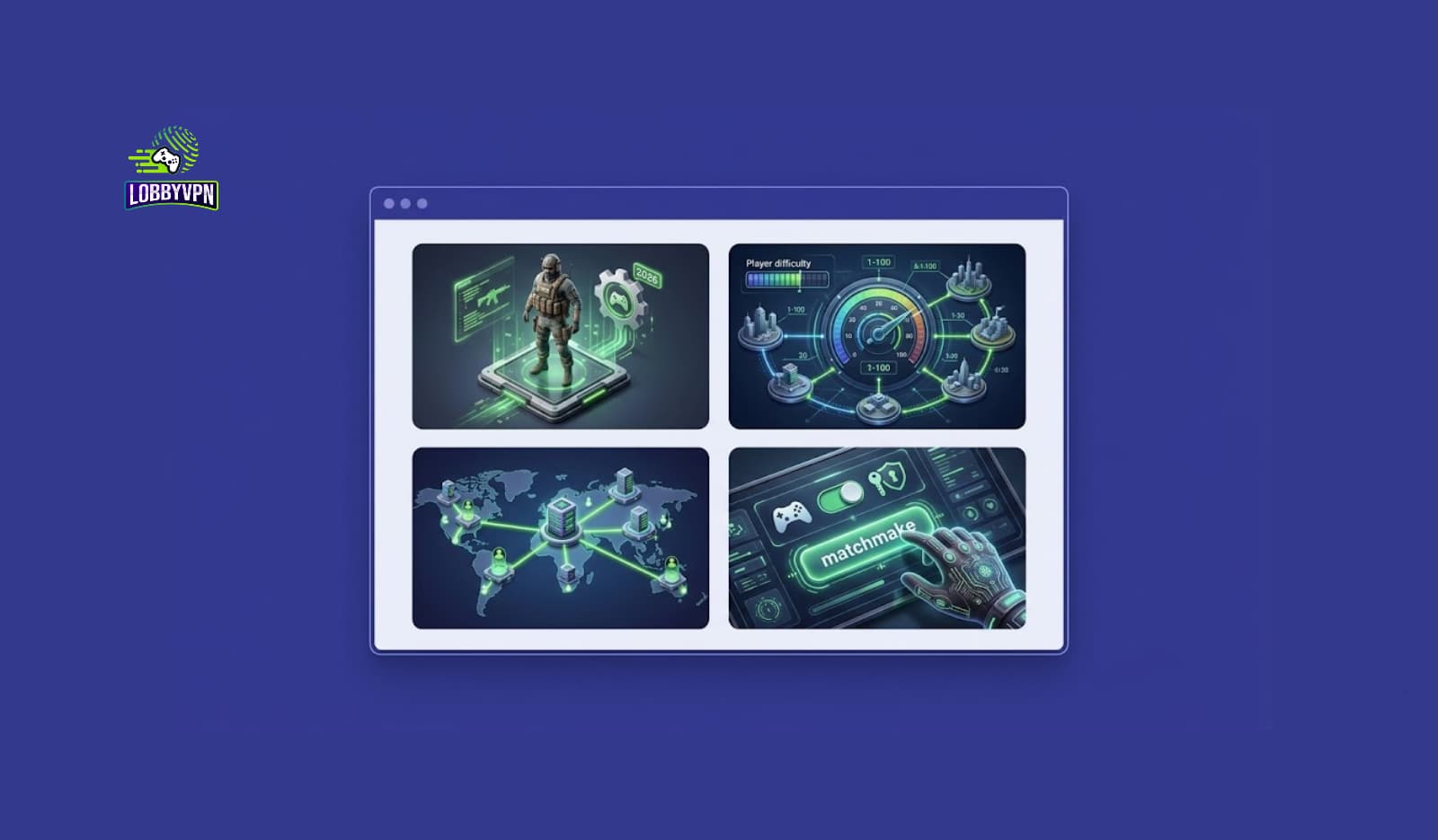
The best COD lobby changer isn’t the app promising bots in every single match, it’s the one that’s honest about what a lobby changer can and can’t actually do to Call of Duty’s matchmaking. That distinction matters more than it sounds, because most of what’s marketed as a “lobby changer” is really just a VPN with a Call of Duty-shaped marketing wrapper, and understanding that difference is the fastest way to stop wasting money on tools that don’t deliver.
This guide breaks down what a COD lobby changer actually is, how it interacts with Skill-Based Matchmaking, which tools genuinely hold up under testing, and how to set one up correctly on PC or console. We’ll rank the strongest options, walk through the setup process step by step, and be upfront about the account-risk side that a lot of marketing pages skip entirely.
What is a COD lobby changer?
A COD lobby changer is any tool, almost always a VPN under the hood, that changes your apparent connection region so Call of Duty’s matchmaking system pulls from a different player pool than your default location would normally offer. Some tools market themselves specifically as “lobby changers” with a gaming-branded interface, while others are general-purpose VPNs that happen to work for the same purpose because they let you pick a server location manually.
Functionally, there’s rarely a meaningful technical difference between a dedicated “lobby changer” and a gaming VPN with solid regional coverage. What separates the good ones from the gimmicks is server placement relative to Activision’s actual matchmaking infrastructure, connection stability once you’re in a match, and honesty about what results you should expect.

How does a lobby changer interact with SBMM?
Skill-Based Matchmaking, or SBMM, builds your lobby around recent performance data — kill-death ratio, win rate, and a handful of other signals Activision doesn’t fully disclose. Alongside that, matchmaking also factors in region and server population to some degree, which is the mechanism a lobby changer is actually working with. Change your apparent region to somewhere with a smaller or more casual player base, and matchmaking may draw from a different pool simply because the available players in that region skew differently.
It’s worth being precise here, since a lot of marketing blurs this line: a lobby changer shifts which population you’re drawn from. It doesn’t erase your skill history or reset your SBMM rating. If you want the full mechanical breakdown of how the system weighs these signals, how SBMM works in Call of Duty covers it in depth, and does Call of Duty use EOMM instead of SBMM digs into the engagement-based theory some players believe runs alongside pure skill matching.
Best COD lobby changers, ranked
We tested and compared these against the criteria that actually matter for lobby changing specifically: regional server coverage relevant to Call of Duty’s matchmaking clusters, latency overhead on distant servers, and transparency about results and risk. Here’s how they stack up.
1. Lobby VPN — best overall COD lobby changer
Lobby VPN takes the top spot because its server network is built around Call of Duty’s actual regional matchmaking infrastructure rather than repurposed from a general privacy-focused server list. That distinction shows up directly in how consistent the results feel session to session, since you’re connecting to locations chosen for gaming relevance in the first place, not just wherever a broader VPN happens to have data centers.
Pros:
- Server locations mapped specifically to regions relevant for Call of Duty matchmaking, including smaller, less saturated player pools
- WireGuard-based routing keeps latency overhead low even on distant regional servers, which matters when you’re testing off-peak regions on the other side of the world
- Built-in DDoS protection and IP masking, so you get real security value even in sessions where the lobby doesn’t end up softer
- Transparent about the mechanics and the ToS gray area, rather than promising guaranteed bots every game
Cons:
- Narrower total server catalog than massive general-purpose VPN providers, since the focus stays on gaming-relevant regions
- Not the right tool if your primary need is unrelated to gaming, like torrenting or general streaming across a dozen platforms
2. Large general-purpose VPN providers (NordVPN, ExpressVPN, and similar)
These providers bring genuinely extensive global server networks and strong general privacy track records, and either one can function as a lobby changer if you manually pick the right region. The trade-off is that server placement wasn’t chosen with Call of Duty’s matchmaking clusters in mind, so results can be more hit-or-miss than a gaming-focused option, even with a large total server count.
Pros:
- Huge server networks across dozens of countries
- Strong reputations for general privacy and security beyond gaming
- Useful for far more than Call of Duty specifically
Cons:
- Server locations optimized for streaming and general browsing, not matchmaking clusters, so lobby-changing results vary more
- Pricing often bundles features a Call of Duty player won’t use day to day
3. Free lobby-changer apps
Free tools are the weakest option here, and it’s not close. Overcrowded servers add exactly the kind of latency that ruins a competitive session, the region selection is usually thin, and the business model behind a genuinely free VPN app is often unclear at best. If cost is a real constraint, our breakdown of best free VPN for Call of Duty covers which limited-tier options are at least transparent about their trade-offs.
Pros:
- No upfront cost
Cons:
- Overcrowded, limited servers add latency rather than reducing it
- Thin regional coverage undercuts the whole strategy
- Data practices are frequently unclear or concerning
How to change your Call of Duty matchmaking region
- Choose a lobby changer with real regional coverage in areas known for smaller, more casual player pools rather than just a high total server count.
- Connect before launching Call of Duty, not mid-session, since switching regions after matchmaking has already started tends to produce inconsistent results.
- Check the local time in your chosen region and aim for its off-peak hours, since timing affects lobby difficulty as much as location does.
- Launch the game and verify your connection region in the in-game network settings to confirm the change registered correctly.
- Play a full session before judging results, since a single match isn’t a reliable sample of whether a region and time combination is working.
- Adjust region or timing if lobbies stay tough, rather than assuming the method has failed after one attempt.
The process is nearly identical across PC, PlayStation, and Xbox, though console setups typically involve a couple of extra network or DNS steps that platform-specific guides cover in more detail.
Does changing your lobby region actually work?
Sometimes, and results genuinely vary enough that any tool guaranteeing bots every match isn’t being straight with you. The pattern that shows up most consistently across community testing and provider data: smaller player pools in regions like the Middle East, North Africa, and Southeast Asia tend to produce softer lobbies more often than major population hubs like US West or Western Europe, particularly during that region’s own off-peak hours.
What tends not to work: connecting to the exact same server every session and expecting identical results, since matchmaking systems continue adjusting and player populations shift by the hour. Region changing is a probability shift, not a fixed override, and setting expectations that way avoids the disappointment that comes from treating it like a guaranteed switch.
Is using a lobby changer against Call of Duty’s rules?
This deserves a straight answer, not a reassuring one. Activision’s Call of Duty Security and Enforcement Policy names spoofing, defined broadly as disguising or obfuscating your identity or hardware identity, as grounds for permanent suspension. That language is broad enough to arguably cover deliberate region switching for matchmaking purposes, even though general VPN use for privacy, security, or reducing ISP throttling isn’t the target of that policy.
In practice, enforcement around region-based lobby changing has been inconsistent, and plenty of players report using this method without any issue. But inconsistent enforcement isn’t the same as a guarantee, and any lobby changer that tells you otherwise is overselling the safety of what it’s offering. If the risk matters to you, treating region selection as an occasional feature layered onto a VPN you’re already using for legitimate security reasons is a more defensible approach than making it your primary, constant strategy.
Lobby changer vs bot lobby VPN vs DNS: what’s the difference?
These three terms get used almost interchangeably in search results, but they’re not identical tools.
| Tool | What it changes | Encrypts traffic | Affects matchmaking region | Affects in-game ping |
|---|---|---|---|---|
| Lobby changer / gaming VPN | Your apparent connection region | Yes | Yes | Sometimes, depending on server and protocol |
| Bot lobby VPN (same category, different marketing) | Your apparent connection region | Yes | Yes | Sometimes, depending on server and protocol |
| DNS server change | Domain name lookups only | No | No | Minimal to none |
A “lobby changer” and a “bot lobby VPN” are, in nearly every practical case, the same underlying tool marketed toward slightly different search intent. DNS is a different category entirely: it resolves domain names and doesn’t touch matchmaking region or traffic encryption. If your goal is genuinely changing your matchmaking pool, DNS isn’t the tool for that job, no matter how it’s marketed. Our full comparison on DNS servers for gaming breaks down what DNS changes actually can and can’t do for a gaming connection.
Expert insights: what separates a real lobby changer from a gimmick?
Testing lobby changers on the support side, the biggest tell is almost always in the region list itself. A tool that lists forty countries but can’t explain why any particular one helps is usually just relabeling a generic VPN’s existing server map. A tool built specifically for Call of Duty tends to concentrate its recommendations around a smaller number of regions that consistently show smaller, more casual player pools, rather than throwing the whole globe at you and hoping something sticks.
The second tell is latency behavior on distant servers. A lobby changer that adds thirty or forty milliseconds the moment you connect to a region on the other side of the world isn’t usable for an actual match, even if the region theoretically has a softer player pool. That’s where protocol choice matters as much as region choice — a modern protocol like WireGuard keeps that overhead low enough that a distant server stays genuinely playable, not just theoretically useful.
The pattern we’d tell any player to watch for: if a lobby changer’s marketing focuses entirely on guaranteed results and never mentions timing, session variance, or the ToS gray area, that’s usually a sign the tool is optimized for sales copy rather than actual gaming performance.
Lobby changing by the numbers
- Independent 2026 protocol benchmarking found WireGuard adding roughly 1 to 3 milliseconds of overhead versus 8 to 12 milliseconds for OpenVPN, a gap that becomes especially relevant on the distant regional servers lobby changing depends on.
- Activision’s published Security and Enforcement Policy explicitly names spoofing, including disguising identity or hardware identity, as grounds for a permanent account suspension, language multiple major gaming-VPN comparison guides note is broad enough to touch matchmaking manipulation specifically.
- Community K/D tracking across major comparison guides consistently shows genuine soft lobbies sitting well below a 1.0 average kill-death ratio, versus SBMM-heavy lobbies that often sit closer to or above 1.0.
- Off-peak local timing in a chosen region shows up repeatedly across provider data and community reports as mattering as much as, or more than, the region choice on its own.
Common mistakes when using a lobby changer
Picking a region without checking local time. A “casual” country during its own peak evening hours can still be tougher than your home region during a slow period.
Assuming more server locations automatically means better results. A huge total server count means nothing if none of those locations correspond to genuinely smaller Call of Duty player pools.
Switching regions mid-match instead of before launching. Changing your connection after matchmaking has already started tends to create instability rather than a cleaner lobby.
Treating a single tough lobby as proof the method failed. Results vary session to session by design, since you’re shifting probability, not forcing a fixed outcome.
Ignoring latency entirely in favor of chasing the “best” region. A theoretically soft lobby on a laggy, distant connection often plays worse than a slightly tougher lobby on a stable one.
Assuming zero ban risk because it “hasn’t happened to anyone I know.” Inconsistent enforcement isn’t the same as a guarantee, and Activision’s own policy language leaves room for this to be treated as a violation.
Best practices for using a lobby changer effectively
- Choose a tool built around Call of Duty’s regions specifically, not a generic VPN’s full global list, since relevance beats raw quantity here.
- Pair region selection with off-peak timing rather than treating either variable on its own as sufficient.
- Prioritize a low-latency protocol like WireGuard so distant, potentially softer regions stay actually playable.
- Test over several sessions before judging results, since a single match is too small a sample to draw conclusions from.
- Know the ToS language going in, and decide your risk tolerance with accurate information rather than a marketing promise.
- Layer in real connection-quality fixes too — our guide on how to reduce lag spikes over Wi-Fi covers the router and network settings that matter regardless of which region you’re connecting through.
- Don’t neglect DDoS protection and IP masking, which are genuine security benefits a good lobby changer provides even in sessions where matchmaking doesn’t cooperate — see how to avoid DDoS attacks while gaming for the fuller picture.
Frequently asked questions
What is a COD lobby changer? A COD lobby changer is typically a VPN that changes your apparent connection region, which can shift the player pool Call of Duty’s matchmaking draws from.
How does a lobby changer work? It routes your connection through a server in a different region, changing your apparent location so matchmaking may pull from a different, sometimes less competitive, player pool in that region.
Does a lobby changer actually get you easier lobbies? Sometimes. Region and off-peak timing together can shift the odds, but results vary by session and aren’t guaranteed, since your performance history still factors into matchmaking.
What’s the best VPN for changing Call of Duty lobbies? A gaming-focused VPN with servers mapped to Call of Duty’s actual regional matchmaking infrastructure, rather than a generic server list, tends to deliver the most consistent results.
Is a lobby changer the same as a bot lobby VPN? Functionally, yes, in nearly every case. Both terms describe the same underlying VPN-based region-switching approach, just marketed toward slightly different search phrasing.
Can a VPN change your Call of Duty matchmaking region? Yes. A VPN changes your apparent connection location, and Call of Duty’s matchmaking factors region into lobby placement alongside your skill history.
Is using a lobby changer against Call of Duty’s rules? It’s a gray area. Activision’s Security and Enforcement Policy names spoofing as grounds for suspension, and that language is broad enough to cover deliberate region manipulation, even though enforcement has been inconsistent.
Does a lobby changer bypass SBMM completely? No. It shifts which population you’re likely matched against, but it doesn’t erase your skill rating or performance history.
How do I set up a VPN to change my COD lobby? Connect to your chosen server before launching the game, verify the region in the in-game network settings, and play a full session before judging whether the region and timing combination is working.
Does DNS work the same way as a lobby changer? No. DNS resolves domain names and has no effect on matchmaking region or traffic routing, so it can’t function as a lobby changer regardless of how it’s marketed.
What’s the best region for easier Call of Duty lobbies? Regions with smaller, more casual player pools — parts of the Middle East, North Africa, and Southeast Asia come up most often — tend to work best, particularly during their own off-peak local hours.
Do free lobby changers work? Rarely, reliably. Overcrowded servers and thin regional coverage usually undercut the results a paid, gaming-focused tool can deliver.
Does a lobby changer affect my ping? It can, in both directions. A nearby, well-optimized server may add only a few milliseconds, while a distant server on an inefficient protocol can add noticeably more.

Key takeaways
The best COD lobby changer isn’t defined by the flashiest promise, it’s defined by honest mechanics: real regional coverage mapped to Call of Duty’s own matchmaking infrastructure, low-latency routing that keeps distant servers actually playable, and straight talk about both the session-to-session variance and the ToS gray area involved. Region and timing work together, not separately, and no tool can override your skill history outright.
That’s the standard Lobby VPN is built around, ranked first here for a reason: gaming-specific server placement, WireGuard-based routing that keeps overhead low even on far-off regions, and DDoS protection and IP masking that deliver real value whether or not a given session lands you a softer lobby. If you’re ready to test a lobby changer that’s upfront about what it can do instead of overselling it, try Lobby VPN and see how your next session actually plays out.