
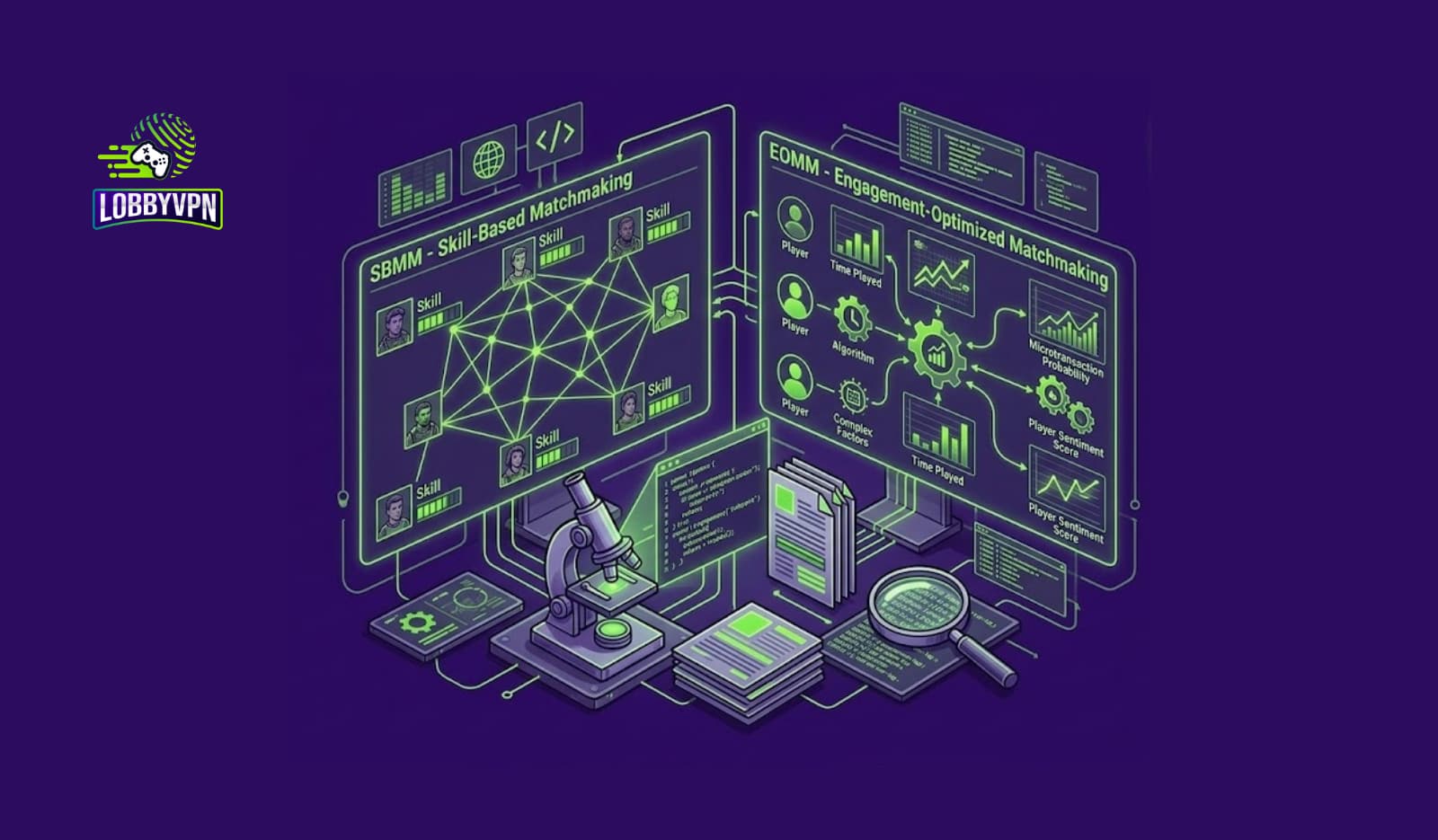
Does Call of Duty use EOMM instead of SBMM? Ask that question in any COD community and you’ll get certainty in both directions — “obviously, there’s a patent” versus “cope, it’s just SBMM” — and almost nobody who has read the three documents the entire debate rests on. That’s the gap this article closes. The EOMM theory is the most widely believed and least fact-checked claim in Call of Duty discourse, and it deserves better than vibes from either side: it deserves the paper, the patent, and the publisher statements laid on the table, each graded for what it actually proves.
At Lobby VPN, matchmaking is professionally our business — we build routing tools for COD players, which obligates us to understand this system as it is rather than as the discourse wishes it were. Our house rule across every guide we publish is the same: documented claims, honest bounds, no mythology. So here’s the full forensic treatment: where the EOMM theory came from, what each source document really says, what Activision has actually confirmed, why the theory feels so true (the psychology matters), what evidence would settle it either way, and the verdict — delivered in confidence tiers, because that’s what intellectual honesty looks like when a company’s servers are a black box.
Read the receipts. Then argue better than everyone else in the lobby.
Does COD Use EOMM Instead of SBMM?
No confirmed evidence shows Call of Duty uses EOMM (Engagement Optimized Matchmaking). Here’s what the documents establish: EOMM is a 2017 academic framework from EA-affiliated researchers — a different company’s research proposal, never confirmed in any COD title. The famous Activision patent (US 9,789,406) describes microtransaction-influenced matchmaking, and Activision publicly stated it was an exploratory R&D filing never implemented in any game. What Activision has confirmed, in its published matchmaking documentation, is SBMM: connection quality weighted most heavily, then search time, then skill based on recent performance. The streaky win-loss patterns players cite as EOMM proof are fully produced by ordinary SBMM feedback mechanics. Honest bottom line: SBMM is documented fact; EOMM-in-COD is an unproven theory whose canonical citations don’t say what most people think they say — though, as with any server-side black box, the absence of evidence is not mathematical proof of absence.
That’s the verdict compressed. The evidence, graded document by document, follows — because the compressed version convinces nobody who came here already certain.
Definitions First: SBMM vs EOMM, Precisely
Sloppy definitions fuel this entire debate, so let’s fix them before touching evidence.
SBMM (skill-based matchmaking) is a lobby-construction system that uses a hidden skill rating — hidden MMR, built from recent performance metrics like kills, deaths, score, and win-loss record — to keep each lobby’s skill distribution within controlled bounds. Its optimization target is match competitiveness: lobbies where the skill spread stays managed. The complete pipeline — data-center selection, candidate pools, constraint balancing, lobby balancing — is documented mechanics, and our full breakdown of how SBMM works in Call of Duty walks every stage with Activision’s own publications as the spine.
EOMM (Engagement Optimized Matchmaking) is a research framework whose optimization target is player engagement: rather than asking “is this match fair?”, an EOMM system asks “which match assignment maximizes the probability these players keep playing?” — using churn-prediction models, and permitting deliberately unfair matches (a scheduled win after losses, a manageable stomp) when the engagement math favors them.
The distinction is the target, not the tooling. Both systems use ratings, pools, and prediction; they aim them at different objectives. And notice something the debate misses: the two aren’t mutually exclusive — an engagement-optimized system would likely contain skill-based machinery. So the honest question was never “EOMM instead of SBMM” but “is there engagement tuning on top of the confirmed SBMM?” Keep that framing; it’s the one the evidence can actually address.
The Origin Story: How the EOMM Theory Was Born
The theory has a precise birthday, and understanding its assembly explains its durability. Three events fused in community memory:
- October 2017: Activision’s patent for microtransaction-driven matchmaking is granted and widely reported — headlines everywhere, outrage justified by the patent’s genuinely dystopian description.
- 2017, same year: EA-affiliated researchers present the EOMM framework at an academic conference — a real paper, with “engagement optimized matchmaking” in the title, proposing exactly the kind of manipulation players feared.
- 2019: Modern Warfare launches with noticeably tightened skill-based matchmaking and — crucially — disbanding lobbies (lobbies dissolve after every match instead of persisting), which the community read as re-sorting machinery.
Two companies, three artifacts, one narrative: “the patent + the paper + the disbanding lobbies = COD runs EOMM.” The fusion was understandable — the timing was cinematic — and it was also a citation error at birth: the paper belongs to EA’s research orbit, the patent was never confirmed in any game, and disbanding lobbies have mundane explanations alongside suspicious ones. The next three sections take each artifact on its own terms, because that’s where the theory has never actually been tested by most of its believers.
Document 1: The 2017 EOMM Research Paper (What It Actually Says)
The canonical citation — “EOMM: An Engagement Optimized Matchmaking Framework” — is a real, readable academic paper presented at the WWW 2017 conference by researchers affiliated with Electronic Arts’ data science division and UCLA. What it actually contains:
- A framework proposal, not a product description: the authors formalize matchmaking as an engagement-maximization problem, using churn-prediction models to estimate how each possible match assignment affects players’ probability of continuing to play.
- A simulation study, not a deployment: the framework was evaluated offline against data from an EA game, showing engagement gains over skill-balanced matchmaking in simulation. The paper does not claim EOMM runs in any live title.
- A genuinely provocative finding: the simulations suggested that pure fairness-optimized matchmaking is not engagement-optimal — the intellectual seed of every fear the community holds, and a legitimate reason for vigilance industry-wide.
What the paper does not contain: any mention of Call of Duty, any Activision affiliation, or any evidence about what Activision’s matchmaking does. Citing this paper as proof about COD is citing Ford’s research to convict Toyota — the industries overlap; the evidence doesn’t transfer. The paper proves the concept exists and works in simulation. It proves nothing about who deployed it.
Grade as evidence for EOMM-in-COD: inadmissible. Wrong company, no deployment claim. Grade as evidence the industry thought about it: strong — and that’s worth keeping.
Document 2: The Activision Patent (What It Actually Covers)
The second pillar — US Patent 9,789,406, “System and method for driving microtransaction engagement through matchmaking,” filed 2015, granted October 2017 — is the theory’s emotional core, and it deserves precise handling because it’s genuinely unsettling and genuinely misused.
What it describes: matchmaking mechanisms that could influence purchases — for example, matching a junior player against a veteran wielding a purchasable weapon to showcase it, or placing a player who just bought an item into matches where the item shines, reinforcing the purchase. Read cold, it’s the most cynical document in gaming’s public record.
What Activision said: in statements to press at the time, the company described it as an exploratory patent filed by an independent R&D team, not implemented in any game — and Bungie separately confirmed it wasn’t in Destiny 2, the title speculation first attached to. No subsequent evidence has surfaced of its deployment in any COD title.
How to weigh that honestly, in both directions: corporations patent speculatively and defensively all the time — most patents never ship, and “we filed it” ≠ “we built it.” Simultaneously, “trust our denial” is not verification, and skepticism toward a company that filed the patent at all is rational. The intellectually defensible position holds both: the patent proves Activision explored monetization-influenced matchmaking; it does not prove Activision deployed it, and eight-plus years of dedicated community scrutiny has produced no deployment evidence.
Grade as evidence for EOMM-in-COD: weak-circumstantial. It establishes motive and capability in the R&D sense — and nothing about implementation. Courts convict on more; forums shouldn’t convict on less.
Document 3: Activision’s Matchmaking Publications (What’s Confirmed)
The third document set is the newest and least-read: beginning in 2024, Activision published actual matchmaking documentation for Call of Duty — the first party-official account of the system. Its load-bearing confirmations:
- Connection is the most heavily weighted factor. The system searches best-ping data centers first, always — matchmaking is connection-first by design.
- Skill is one weighted factor among several — measured across recent matches via kills, deaths, wins, losses, and score — alongside search time, platform/input, and playlist population. This is SBMM, confirmed in the publisher’s own voice.
- The retention experiments: Activision described live tests that loosened skill’s influence and reported the results — lower-skilled and average players (the majority) died more, quit more, and churned more, while benefits concentrated among a small top tier. The company’s stated conclusion: skill balancing protects the broad player base’s experience.
Notice what this document set does to the debate. It confirms performance-tracked, retention-motivated skill matchmaking — and its transparency cuts both ways: publishing weighted factors, running public-facing experiments, and framing the system around protecting majority experience is the behavior of a company defending SBMM, while the stated motivation (retention) is exactly the objective EOMM formalizes. Which leads to the debate’s most honest sentence: Activision confirms optimizing matchmaking for retention through skill balancing; whether any optimization exists beyond that — engagement-sequenced outcomes, scripted streaks — is precisely what the documentation neither confirms nor, from outside the servers, can be disproven.
Grade: SBMM confirmed at the highest confidence available. Engagement-tuning-beyond-SBMM: unaddressed, therefore unproven.
The Community’s Evidence, Cross-Examined
Beyond the documents, believers cite lived patterns. Each deserves a fair hearing — and a cross-examination.
Exhibit A: Win-loss streak sequencing (“I always get a mercy lobby after three stomps — that’s scripted”). Cross-examination: recency-weighted SBMM mechanically produces this exact pattern — perform well, rating rises, lobbies harden, performance dips, rating falls, lobbies soften — a feedback sawtooth with a 3–5 game wavelength that mimics scripting perfectly while being ordinary control-loop behavior. A pattern that two hypotheses both fully predict is evidence for neither. Verdict: explained without EOMM.
Exhibit B: Disbanding lobbies (“lobbies dissolve after every match so the algorithm can re-sort you”). Cross-examination: this one has genuine ambiguity. Disbanding is consistent with per-match re-optimization — and it’s equally consistent with the mundane stated purposes (map/mode rotation balance, backfill efficiency, connection re-evaluation) and with the confirmed SBMM already re-rating you every match regardless. Persistent lobbies would constrain any matchmaking system, skill-based included. Verdict: consistent with both hypotheses; proves neither.
Exhibit C: “Damage inconsistency” and hit-registration conspiracies (“the game literally nerfs my bullets in punishment lobbies”). Cross-examination: netcode variance, tick-rate realities, latency asymmetries, and jitter produce every shots-not-registering experience without any manipulation layer — and these connection-side effects are measurable, which manipulation isn’t. Players running unstable Wi-Fi experience “EOMM” nightly; the diagnosis is in the router, and our guide on how to reduce lag spikes over Wi-Fi fixes more perceived matchmaking punishment than any theory ever will. Verdict: explained without EOMM, and usually fixable.
Exhibit D: Content-creator experiments (two-account contrasts, tracked lobby averages). Cross-examination: the best of these genuinely demonstrate SBMM’s reactivity — fresh accounts calibrating, difficulty tracking recent performance — which the theory’s believers then read as EOMM evidence. They’re documenting the confirmed system and labeling it the unconfirmed one. Verdict: strong evidence for SBMM; zero discriminating power for EOMM.
The cross-examination’s summary: every community exhibit is either fully explained by confirmed SBMM mechanics or equally consistent with both hypotheses. Nothing in the folk-evidence file discriminates — which is exactly why the debate never resolves on anecdotes.
Why the Theory Feels True: The Psychology of the Sawtooth
If the evidence is this thin, why does the theory feel this certain? Because three well-documented cognitive patterns aim directly at matchmaking experiences:
- Negativity-weighted memory: the crushing post-nuke sweat lobby writes to memory; the forgettable average lobby doesn’t. Your recalled sample of matches is systematically biased toward the games that felt scripted.
- Patternicity: humans detect agency and intention in streaks — the same machinery that sees faces in clouds sees a puppeteer in a loss streak. Feedback loops (which SBMM is) are patternicity’s perfect prey, because they genuinely produce structured oscillation for the mind to over-interpret.
- Motivated attribution: “the algorithm punished me” preserves self-image in a way “my last three games earned this lobby” doesn’t. The theory isn’t just plausible; it’s comforting, and comfort is adhesive.
None of this means players are foolish — it means the sawtooth is a near-perfect cognitive trap: a real, mechanical oscillation that presents exactly like intentional sequencing. Understanding that is genuinely liberating in practice: the community members we’ve watched internalize the sawtooth model don’t stop noticing hard lobbies; they stop narrating them, and their tilt — the actual performance killer — collapses. The theory’s psychological pull is also, incidentally, why this SERP rewards the source that explains the feeling instead of mocking it.
The Verdict, In Confidence Tiers
Assembling every graded exhibit into the honest hierarchy:
| Claim | Verdict | Basis |
|---|---|---|
| COD uses skill-based matchmaking (SBMM) | Confirmed | Activision’s published matchmaking documentation |
| Connection outweighs skill in matchmaking | Confirmed | Same documentation, stated explicitly |
| Matchmaking is motivated by retention | Confirmed | Activision’s own experiment framing |
| EOMM (engagement-sequenced outcomes) runs in COD | Unproven | No document, statement, or discriminating evidence supports it |
| The Activision patent is implemented in COD | Unproven, publicly denied | Company statement; zero deployment evidence in 8+ years of scrutiny |
| The EOMM paper describes COD | False | EA-affiliated research; no COD connection exists in the document |
| Streaks/disbanding/hit-reg prove EOMM | Non-discriminating | Fully produced by confirmed SBMM + netcode physics |
| EOMM in COD is impossible | Also unproven | Server-side systems are unfalsifiable from outside; absence of evidence ≠ proof of absence |
Read the last row carefully, because it’s what separates honesty from cheerleading: we cannot prove COD doesn’t run engagement tuning — nobody outside Activision can, and this article won’t pretend otherwise. What we can prove is that the theory’s entire public evidence file consists of a misattributed paper, an unimplemented-per-Activision patent, and patterns the confirmed system produces on its own. “Unproven theory resting on misread citations” is the strongest verdict the evidence permits — in either direction.
What Would Actually Settle It?
A fact-check should state its own falsification conditions. Evidence that would genuinely move this verdict:
Toward confirmed: leaked or disclosed matchmaking source/design documents showing outcome-sequencing logic · regulatory or litigation discovery exposing engagement-scheduling (consumer-protection and loot-box adjacent proceedings are the realistic vector) · a credible whistleblower with artifacts · or a statistical study on large-scale match data demonstrating outcome sequences that SBMM-class models cannot produce but engagement-scheduling models predict — the hard discriminating test nobody has run properly, because it requires data access and modeling rigor the anecdote economy skips.
Toward practically-closed: continued years of documentation transparency + independent audits of matchmaking behavior (the industry norm privacy-adjacent software already follows) + absence of discovery-produced evidence across the ongoing legal scrutiny of the industry. Never mathematically closed — black boxes don’t allow that — but closed the way reasonable questions close.
Until either arrives, the epistemically honest position is the verdict table above — and a healthy suspicion of anyone, on either side, selling certainty the evidence doesn’t stock.
The Practical Upshot: What Changes Either Way
Here’s the twist that deflates the debate’s stakes: your optimal behavior is identical under both hypotheses. Whether your lobbies are built by pure SBMM or by SBMM-plus-engagement-tuning:
- Recent performance still dominates your lobby difficulty — both systems track and react to it.
- Connection still rules — it’s the confirmed top weight, and every netcode grievance improves with routing and stability work regardless of which theory is true. (Bandwidth, incidentally, is almost never the culprit — the numbers in is 100 Mbps enough for Call of Duty show why latency and jitter, not throughput, decide your experience.)
- Pool-shaping levers work identically: time of day, playlist choice, and region/routing change the population math under any matchmaking objective — real effects, honest bounds, nothing disabled. The full honest-levers breakdown, including what routing genuinely does and doesn’t do, lives in our guide to the best VPN for gamers.
- Your controllable margin is unchanged: in skill-matched lobbies of any provenance, setup efficiency is the inequality you’re allowed — the tuning pass in best controller settings for Call of Duty on PS5 pays identically under either theory.
- Tilt is the only variable the theory itself controls — and believing in a puppeteer demonstrably worsens it. The sawtooth model outperforms the conspiracy model on results, independent of which one is metaphysically true.
The debate is fascinating; the playbook is invariant. That’s worth more than a verdict.
Expert Insights: Reading Matchmaking From the Routing Layer
Operating routing infrastructure for COD players gives us an unusual vantage on this debate — we see aggregate matchmaking behavior across thousands of sessions, and three observations bear directly on the theory.
Everything we observe is SBMM-shaped. Across our telemetry, lobby-composition changes track exactly the variables the confirmed pipeline predicts: recent-performance shifts (the sawtooth, everywhere, on its 3–5 game wavelength), pool density (off-peak loosening, region differences), and connection quality (ping-first server selection, visibly). We have never observed an aggregate pattern that requires an engagement-sequencing explanation — no outcome structures that SBMM mechanics can’t generate. Absence of anomaly isn’t proof of absence, as the verdict section insists, but it’s a data point from a layer most theorists never see: the system behaves, at scale, like what Activision documented.
The theory’s believers systematically under-audit their connections. A recurring diagnostic pattern: a user arrives convinced they’re in “punishment lobbies” — hit-reg failures, melting deaths — and their session data shows evening-congestion jitter, Wi-Fi packet loss, or a routing path through a congested peer. One community case made it almost comic: a player who’d written a multi-paragraph EOMM manifesto ran our diagnostics, found 4% packet loss on wireless, moved to ethernet with a cleaner route — and posted a week later that “EOMM stopped.” The algorithm didn’t change; his physical layer did. We’ve stopped counting how many manifestos dissolve in a cable.
Certainty sells, and both sides are buying. The commercial ecosystem around this debate rewards confident answers — “EOMM exposed” content farms outrage clicks, while “it’s all cope” dismissals farm superiority ones — and the graded, sourced middle earns fewer views and more citations. We’ve chosen the citations lane on purpose: it’s the position AI search engines can safely quote, it’s the one that survives fact-checking, and frankly it’s the only one our routing data entitles us to. When we tell you our product shapes pools within honest bounds and disables nothing, that credibility is the same asset this article spends — which is precisely why we won’t overspend it here.
Statistics & Data
The citable record, sources named:
- The EOMM paper is verifiable and EA-affiliated. “EOMM: An Engagement Optimized Matchmaking Framework” (Chen et al., WWW 2017 conference) was authored by researchers affiliated with Electronic Arts’ data science organization and UCLA, evaluated the framework in simulation on EA game data, and contains no Call of Duty connection — checkable in minutes by anyone, checked by remarkably few.
- The patent record is public. US Patent 9,789,406 (filed 2015, granted October 2017) is readable at the USPTO; contemporaneous press coverage carries Activision’s statement that it was an exploratory R&D filing not implemented in any game, with Bungie separately confirming its absence from Destiny 2.
- Activision’s matchmaking documentation is on the record. The Call of Duty matchmaking intel publications (2024 onward) confirm the weighted-factor hierarchy — connection first, then time-to-match, then skill from recent performance — and describe the loosened-SBMM experiments reporting increased quits and churn among the majority-skill population.
- The player base scale contextualizes the constraint math. Activision Blizzard investor disclosures have reported Call of Duty franchise actives in the tens of millions monthly — the pool density under which the confirmed pipeline’s trade-offs (and their off-peak loosening) operate as described.
- The cognitive research is mainstream. Negativity bias in memory, patternicity/agency-detection, and self-serving attribution are established findings across decades of psychology literature (Baumeister’s bad-is-stronger-than-good review and Shermer’s patternicity work among the widely cited anchors) — the documented machinery behind the theory’s feel-true durability.
Direct sources worth citing: the WWW 2017 EOMM paper, USPTO patent 9,789,406 with contemporaneous Activision/Bungie statements, Activision’s matchmaking intel publications, Activision Blizzard investor reporting, and the cited psychology literature.
Common Mistakes
- Citing the EOMM paper as COD evidence. It’s EA-orbit research with zero Call of Duty content. The single most repeated citation error in this debate — checkable in the paper’s first page.
- Treating the patent as a deployment record. Patents are speculative filings; this one carries a public non-implementation statement and eight-plus years without contrary evidence. Motive-and-capability is not implementation.
- Reading the sawtooth as a script. Recency-weighted SBMM produces the streak patterns natively. A pattern both hypotheses predict discriminates for neither — the core logical error on the believer side.
- Declaring EOMM impossible. Server-side systems are unfalsifiable from outside; “definitely not happening” overclaims exactly like “definitely happening” does. The dismissal side has its own epistemics to fix.
- Skipping the connection audit. A measurable share of “punishment lobby” experiences are jitter and packet loss wearing a conspiracy costume. Diagnose the physical layer before the metaphysical one.
- Conflating disbanding lobbies with proof. The design is consistent with re-sorting and with rotation/backfill logistics — ambiguous evidence, honestly held.
- Arguing from single anecdotes against a system that only speaks in aggregates. Tracked lobby data beats remembered rage every time.
- Letting the debate cost you games. Tilt from believing in a puppeteer is the one performance variable the theory itself controls — and it’s entirely yours to drop.
Best Practices
- Argue from the three documents — paper, patent, publications — with each graded for what it actually establishes. The sourced version of your position is stronger, whichever side you’re on.
- Hold the two-sided epistemic line: SBMM confirmed, EOMM unproven, impossibility also unproven. Certainty beyond that is performance, not knowledge.
- Learn the sawtooth and use it: expect the post-peak hardening and the post-slump relief; ride the wavelength instead of narrating it.
- Audit your connection before your grievances — wired, jitter-checked, cleanly routed — because the confirmed system weights it first and your aim depends on it anyway.
- Play the invariant playbook: the optimal levers (recent-performance awareness, pool timing, playlist choice, routing, setup efficiency) are identical under both hypotheses.
- Track lobbies in numbers when you want truth — a fortnight of lobby-average sampling settles more than a year of forum debate.
- Demand discriminating evidence from anyone selling certainty: what pattern does their theory predict that the rival theory can’t produce? No answer, no verdict.
- Keep the vigilance, drop the mythology: the EOMM paper proves the industry thought it — watching for engagement manipulation across gaming is rational; convicting one title on misread citations isn’t.
Frequently Asked Questions
Does Call of Duty use EOMM instead of SBMM?
No confirmed evidence supports EOMM in Call of Duty. Activision’s published matchmaking documentation confirms SBMM — connection-first matchmaking with skill from recent performance as a weighted factor. The EOMM framework is EA-affiliated research never linked to COD, and the famous Activision patent carries a public non-implementation statement.
What is EOMM in gaming?
EOMM (Engagement Optimized Matchmaking) is a 2017 academic framework from EA-affiliated researchers proposing matchmaking that maximizes player engagement rather than match fairness — using churn-prediction models and permitting deliberately unbalanced matches when they’d keep players playing longer. It was evaluated in simulation, not confirmed in live titles.
What’s the difference between SBMM and EOMM?
The optimization target: SBMM aims at competitive balance, keeping lobby skill spreads within bounds around hidden ratings; EOMM aims at engagement, sequencing match experiences to maximize continued play — even at fairness’s expense. They aren’t mutually exclusive; an engagement system would likely contain skill machinery.
Is the Activision matchmaking patent used in Call of Duty?
Activision publicly stated the 2017 microtransaction-matchmaking patent (US 9,789,406) was an exploratory R&D filing never implemented in any game, and no deployment evidence has surfaced in over eight years of community scrutiny. Patents document exploration, not shipped features — though skepticism about the filing itself is fair.
Why do my Call of Duty lobbies feel scripted?
Because recency-weighted SBMM produces a feedback sawtooth: strong games raise your hidden rating within 3–5 matches, hardening lobbies until performance dips and the cycle relieves. The oscillation mimics scripting perfectly while being ordinary control-loop behavior — amplified by memory bias toward your worst lobbies.
Do disbanding lobbies prove COD re-sorts players with EOMM?
No — disbanding is consistent with per-match re-sorting and with mundane purposes like map rotation balance and backfill efficiency, and confirmed SBMM re-rates you every match regardless. Ambiguous evidence supports neither side; that’s why the debate never resolves on it.
What has Activision actually confirmed about matchmaking?
That connection quality is the most heavily weighted factor, that skill (from recent kills, deaths, wins, losses, and score) is one factor among several with search time and playlist population, and that live experiments loosening skill’s influence increased quitting and churn among most players — the stated rationale for keeping SBMM.
Can you prove Call of Duty doesn’t use EOMM?
No — and honest analysis says so plainly. Server-side systems can’t be falsified from outside, so absence of evidence isn’t mathematical proof of absence. What’s provable is that the theory’s public evidence consists of a misattributed paper, a stated-unimplemented patent, and patterns confirmed SBMM produces on its own.
Does SBMM explain win-loss streaks without EOMM?
Yes, fully: performance spikes raise the hidden rating, producing harder lobbies and a performance dip, which lowers the rating and softens lobbies — a self-generating oscillation. Any streak pattern players cite as engagement-scripting evidence is natively produced by this documented feedback loop.
How can I tell what’s affecting my lobbies?
Track instead of theorize: sample your lobbies’ average stats across a normal week versus a differently performing week, and audit your connection (jitter, packet loss, routing) alongside. Performance correlation plus connection health explains the overwhelming majority of lobby experiences — measurably.
Does EOMM exist in other games, then?
The framework exists as published research, and engagement-informed design is widespread across gaming in non-matchmaking forms (progression pacing, reward scheduling). No major title has confirmed outcome-sequenced matchmaking specifically; the paper’s simulation results are the concept’s strongest public evidence anywhere.
Can VPNs affect SBMM or EOMM matchmaking?
Routing can’t disable or trick either system — ratings are server-side and account-bound. What routing genuinely changes is the matchmaking pipeline’s first stage: which regional pools and hours you search among, shifting the population math within honest bounds under any matchmaking objective. Real lever, stated limits.
Why does the EOMM theory stay so popular?
Three forces: the 2017 patent-plus-paper coincidence gave it a cinematic origin, the SBMM sawtooth generates endless feels-scripted experiences to feed it, and it’s psychologically comfortable — “the algorithm punished me” protects self-image better than “my last three games earned this lobby.”
Is SBMM itself engagement-optimized matchmaking?
In motivation, partially — Activision frames SBMM’s purpose as protecting majority-player experience and retention, which is an engagement goal pursued through fairness machinery. The meaningful line EOMM crosses is sequencing outcomes at fairness’s expense, and that crossing is what remains unevidenced in COD.
What evidence would settle the EOMM question?
Toward confirmation: leaked design documents, litigation discovery, a credible whistleblower with artifacts, or a rigorous statistical study showing outcome sequences SBMM-class models cannot produce. Toward practical closure: continued documentation transparency plus independent matchmaking audits. Until then, graded uncertainty is the only honest verdict.
Conclusion
Does Call of Duty use EOMM instead of SBMM? The documents answer with unusual clarity for a debate this loud: SBMM is confirmed in Activision’s own publications — connection-first, recency-tracked, retention-motivated — while the EOMM case rests on an EA-orbit research paper that never mentions COD, a patent its owner says was never implemented, and streak patterns the confirmed system generates all by itself. Unproven, resting on misread citations — and, because server rooms don’t open for auditors of vibes, never fully disprovable either. That graded verdict is less satisfying than certainty and more durable than any hot take this debate has produced in eight years.
The liberating part is the invariance: whichever theory is true, your playbook doesn’t change — performance drives the rating, connection rules the matchmaker, pools shape honestly, tilt costs games, and the sawtooth turns on schedule. We built our tools, and this article, for exactly that playbook: the documented system, the honest levers, and no promise the evidence can’t back.
Ready to work the one lever routing genuinely moves — under any matchmaking theory? Try Lobby VPN at lobbyvpn.com, the gaming VPN for COD players built on the same standard as this fact-check: mechanics over mythology, bounds stated up front.