
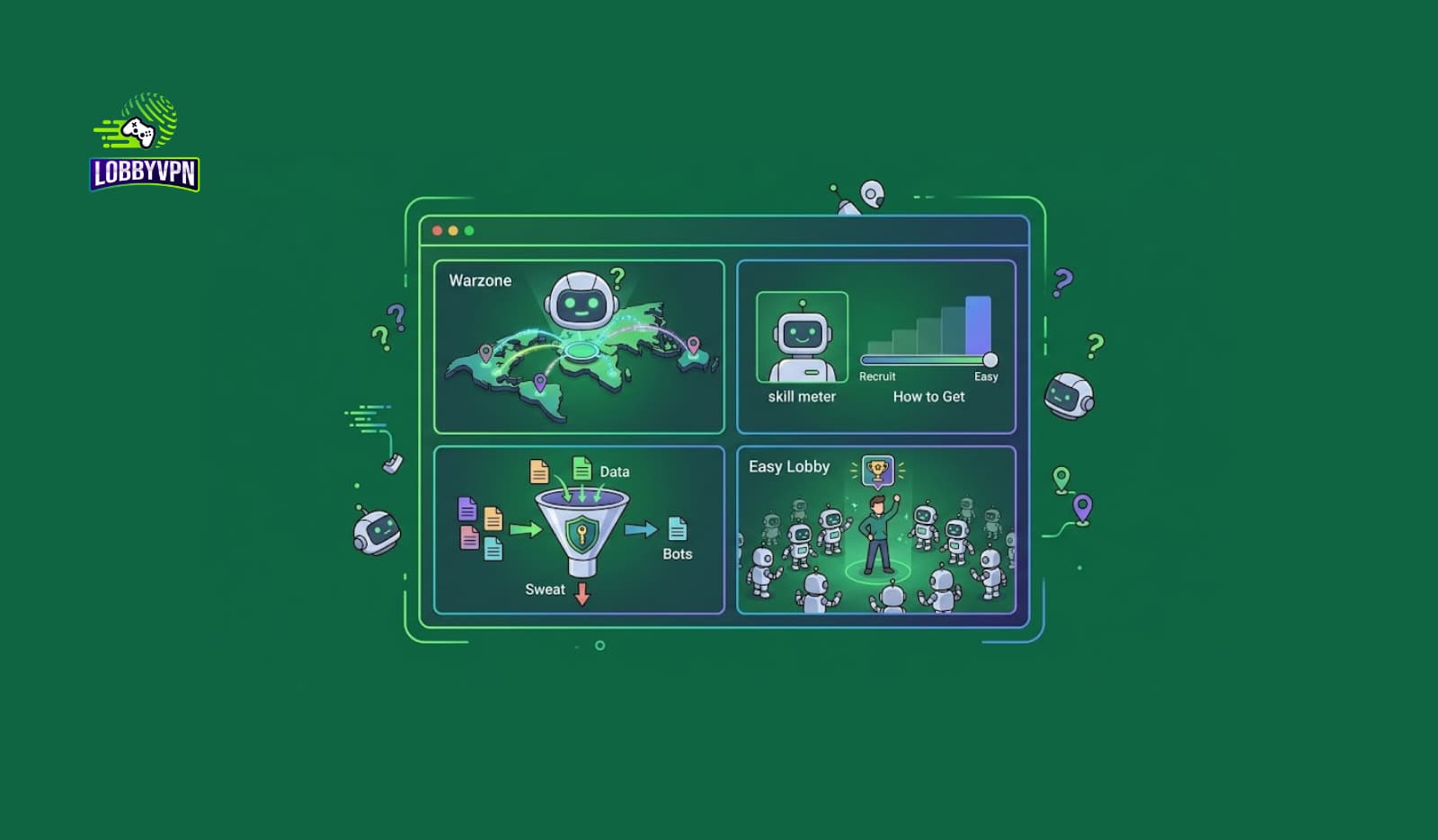
Search “how to get bot lobbies in Warzone” and you’ll find a dozen sites promising a guaranteed switch that turns your next match into a stress-free stomp. None of them can actually promise that, and honestly, neither can we. What we can do is explain what a bot lobby actually is, why the term gets thrown around more loosely than it should, and which methods genuinely shift your Warzone matchmaking toward easier games instead of just draining your wallet on a tool that doesn’t do much.
This guide covers the real mechanics behind Warzone’s skill-based matchmaking, tests the two methods players actually try, and lays out the honest, documented version of where a VPN fits into the picture. No guaranteed bot lobby promises here, because nobody can make that promise truthfully.
What Are Bot Lobbies in Warzone, Really?
A true bot lobby, in the strictest sense, is a match where most opponents play like AI bots: no movement, no game sense, barely any resistance. Those matches are rare and usually tied to very specific, thin-population conditions rather than anything a player can reliably trigger on command.
What most players actually mean by “bot lobby” is looser: a noticeably easier match, full of below-average or new players, where the effort required to win drops sharply compared to a normal sweaty session. That distinction matters for this whole topic. Chasing a guaranteed, literal bot lobby is chasing something that doesn’t exist as an on-demand feature. Chasing a genuinely easier lobby, on the other hand, is realistic, and there are documented ways to move the odds in your favor.

Why Warzone Feels So Sweaty in the First Place
Warzone’s matchmaking is built around skill-based matchmaking, commonly shortened to SBMM, which uses a hidden rating built from your recent performance to shape who you’re matched against. Our deep dive on how SBMM works in Call of Duty covers the full mechanics, but the short version is this: connection quality gets weighed first, then queue time, then your skill rating, which updates after nearly every match based on your recent kills, deaths, wins, and losses.
Because Warzone squeezes 100-plus players into a single lobby instead of the 12 you’d see in multiplayer, that same skill weighting gets diluted across a much bigger, more varied pool. In practice, that means the population searching for a match at your exact moment, in your exact region, ends up shaping lobby difficulty almost as much as your own rating does. That single fact is the real foundation behind every legitimate method for finding easier games, and it’s worth understanding before trying anything else on this list.
The Two Methods Players Actually Try
Two-Boxing (No Longer Effective)
Two-boxing involved running a second, low-skill account on a separate device to try to drag your main account into an easier bracket. It made the rounds for a while, but Activision’s matchmaking has been adjusted specifically against this kind of manipulation, and most players report it no longer produces any reliable effect. It’s not worth your time or a second console purchase at this point.
Regional and Timing Adjustments (Still Effective)
This is the one method with a real, documented mechanism behind it. Warzone’s matchmaking selects your data center based on your network location before skill enters the equation at all. Change your effective region, and you change which regional player pool your search draws from, not your hidden skill rating, which stays attached to your account no matter where you connect from.
Two variables drive this the most:
- Time of day. A 3 a.m. queue on a quiet server pulls from a thinner, often less competitive population than Saturday evening prime time.
- Region. Some regions carry a larger casual player base relative to their competitive scene, which changes the average difficulty of the pool your lobby gets built from.
This is where a VPN legitimately enters the conversation, and it’s worth being precise about what it does and doesn’t do.
Where a VPN Actually Helps (And Where It Doesn’t)
Here’s the claim that needs correcting, because it’s repeated constantly across this niche: a VPN does not disable, lower, or trick Warzone’s skill-based matchmaking. Your hidden rating travels with your account regardless of which server you connect through. Anyone promising a tool that “turns off SBMM” is selling something that doesn’t match how the system is actually built.
What a VPN genuinely changes is the population variable described above. Routing your connection through a different region changes which data centers your search considers and, by extension, which regional pool of players your lobby gets drawn from. Since that pool has its own density, skill spread, and local time of day, the practical effect can be a real, noticeable shift in average lobby difficulty, even though the underlying algorithm hasn’t moved an inch.
The honest trade-off: routing farther adds latency, and Warzone’s ping-first matchmaking will resist a genuinely bad connection rather than reward it. A softer lobby isn’t worth losing every close gunfight to a 150ms delay. This is also why a gaming-grade VPN matters more than a general privacy one here. A VPN built for streaming or browsing isn’t optimized for the routing quality Warzone rewards, and a lot of the “free bot lobby” tools flooding this niche fall apart under exactly that test. We break down which free options are actually worth trying, and which aren’t, in our review of the best free VPN for Call of Duty.
Lobby VPN was built around this exact honest mechanism: latency-first routing designed specifically for Call of Duty’s server infrastructure, so region control doesn’t cost you the connection quality that makes a lobby winnable in the first place. If you’re comparing options more broadly, our best VPN for gamers guide covers the full buyer’s checklist, and our dedicated walkthrough on a gaming VPN for COD players goes deeper into setup for Warzone specifically.
Step-by-Step: Testing Regional Routing the Right Way
- Pick a gaming-optimized VPN, not a general-purpose one. Streaming-focused VPNs route for entertainment traffic, not real-time matchmaking.
- Connect to a region with a different time zone than your own, ideally one currently in an off-peak window.
- Check your ping before queuing. If it’s climbed past a level you’re comfortable playing on, the trade-off likely isn’t worth it. Our guide to reducing lag spikes over Wi-Fi covers the connection basics worth fixing first, VPN or not.
- Play a handful of matches, not just one. A single easy or hard lobby is noise. A pattern across five or more matches tells you whether the region is actually working for you.
- Log what works. Keep a rough note of which regions and hours produced noticeably easier sessions. Your own personal pattern is more useful than any generic “best server” list, since population shifts by the hour.
- Rotate if a region stops working. Regional populations aren’t static. What felt soft last month can tighten up as more players discover the same pattern.
Common Mistakes Players Make Chasing Bot Lobbies
- Trusting a “guaranteed bot lobby” claim. No legitimate tool can promise this, since population shifts constantly and skill still enters the matchmaking calculation. Treat any guarantee as a marketing red flag rather than a technical fact.
- Judging a region after one match. One lobby reflects the queue’s mood that minute, not a reliable pattern. Give any region at least five matches before deciding it works.
- Ignoring the ping cost. A distant server might pull a softer population, but if it adds 100ms or more, you’ll lose gunfights the easier lobby was supposed to hand you.
- Assuming free VPNs perform the same as paid, gaming-optimized ones. Most free “bot lobby” tools either do nothing measurable or degrade your connection enough to offset any population benefit.
- Reverse boosting to chase easier matches. Deliberately losing does lower your rating temporarily, but it throws games for random teammates, violates fair play policies, and corrects itself the moment you play normally again. It’s a mistake worth avoiding entirely, not a shortcut.
Best Practices for Consistently Easier Warzone Sessions
Getting a genuinely easier session more often comes down to stacking small, honest advantages rather than finding one magic trick.
- Play during off-peak hours in your own region before trying to route elsewhere.
- Test two or three candidate regions over a week rather than committing to one immediately.
- Keep your connection stable and low-latency regardless of region, since packet loss flattens good and bad players alike.
- Squad with a consistent group rather than solo-queuing, since party skill blends into the matchmaking target differently than solo search does.
- Accept that a rough personal patch will soften your own lobbies naturally within a few matches, since the rating is built from recent form.
Frequently Asked Questions
How do you get bot lobbies in Warzone?
There’s no guaranteed method, since true bot lobbies depend on population conditions nobody can trigger on command. The realistic approach combines off-peak timing, regional routing through a gaming-optimized VPN, and stable connection quality, which together shift the odds toward easier matches without disabling matchmaking outright.
Can a VPN really get you bot lobbies in Warzone?
A VPN can’t disable SBMM or guarantee bot-filled matches. What it genuinely does is change which regional player pool your search draws from, which can produce noticeably easier average lobbies, especially when paired with off-peak timing.
Is using a VPN for Warzone against the rules?
Activision’s terms of service take a cautious stance on matchmaking manipulation broadly, and no provider can promise zero risk. Routing through a different region for latency or population reasons is common practice, but players should read current terms themselves rather than rely on any guide’s blanket assurance.
What is the best VPN location for bot lobbies in Warzone?
There isn’t one universal answer, since regional population shifts by time of day and month. The more reliable approach is testing two or three regions over a week and tracking which ones consistently produced easier sessions for your own schedule.
Does two-boxing still work for easier Warzone lobbies?
No. Activision has adjusted matchmaking specifically against this kind of manipulation, and most players report it no longer produces a reliable effect.
Why do my Warzone lobbies feel harder some days than others?
Usually a mix of three factors: your recent performance raised your hidden rating, you’re queuing during a more competitive time window, or the regional population you’re matched from currently skews harder than usual.
Does a VPN affect Warzone ping?
It can, in both directions. A well-routed, gaming-optimized VPN can sometimes stabilize or even improve ping by avoiding congested default routes. A poorly chosen distant region will add latency, which is the honest trade-off to weigh against any population benefit.
Do free VPNs work for getting easier Warzone lobbies?
Some do very little, and a few actively hurt your connection more than they help your matchmaking. Free tiers of gaming-focused VPNs are worth testing cautiously; general-purpose free VPNs built for browsing or streaming usually aren’t optimized for real-time matchmaking traffic at all.
Is reverse boosting a good way to get easier lobbies?
No. It works only temporarily, throws matches for teammates, and violates fair play policies, all for an effect that disappears the moment you resume playing normally.
How long does it take to notice a difference after switching regions?
Give it at least four or five matches. A single lobby reflects the moment’s queue conditions rather than a stable pattern, so short-term judgments tend to be misleading either way.

Final Words
Bot lobbies, in the literal sense, aren’t something any tool can guarantee, and treating that claim as fact is the fastest way to waste money in this niche. What’s real and documented is simpler: Warzone’s matchmaking weighs connection and population before skill fully applies, which means timing, region, and connection quality are genuine, controllable levers, even though your hidden skill rating stays exactly where it is.
A gaming-optimized VPN belongs in that toolkit as a population-and-latency lever, not a magic SBMM switch. That’s the honest version of this method, and it’s the version we built Lobby VPN around: routing engineered specifically for Call of Duty’s servers, so testing a region doesn’t cost you the connection quality that makes any lobby, easy or hard, actually winnable.
If you want to test regional routing properly instead of guessing, that’s exactly what Lobby VPN is built for. Try it, log your own results over a week, and judge the difference for yourself, no bot lobby guarantees required.